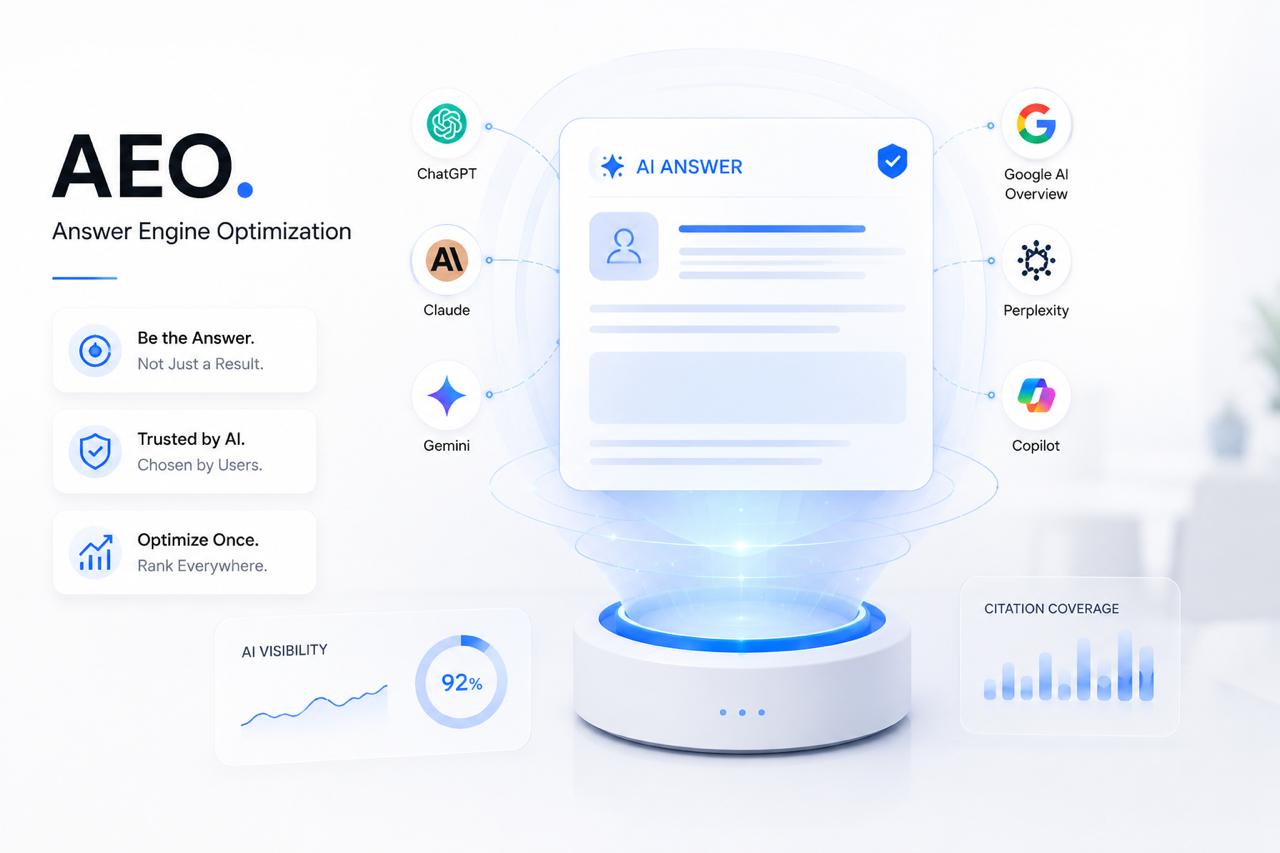
That shift sounds small. The consequences are large. It changes what you publish, how you structure it, and how you measure whether it worked. This guide explains what AEO means, how answer engines decide who to cite, how it differs from the SEO most teams still run, and what changes when the field is healthcare. It is the hub for our wider series on AI discovery, and the later posts go deeper on each piece.
What answer engine optimisation actually means
For two decades, the job of digital marketing was to rank. You produced a page, you earned links and authority, and you tried to sit near the top of a results page so a person would click through to your site. The person did the reading. The person made the choice.
Answer engines remove that step. When someone asks ChatGPT for the best cardiac hospital in a city, or asks Google for the side effects of a drug, the system does not hand back ten links and leave the judgement to the user. It reads the sources itself, decides which ones to trust, and writes a single answer. Sometimes it names its sources. Often it does not.
This is already the default for a large share of search. Google's AI Overviews reached more than two billion monthly users by mid-2025, across more than 200 countries (Google, reported by TechCrunch). ChatGPT passed 800 million weekly active users in 2025 (OpenAI). Google's newer AI Mode reached around 100 million users in the United States and India specifically (TechCrunch). The audience that once scrolled a results page is now reading a generated answer instead.
AEO is the work of making sure that when those answers are written, your information is in them. It has three parts:
- Findable. The engine can reach your content, parse it cleanly, and understand what each page is about.
- Trustworthy. The engine has reason to treat your information as accurate, current, and authored by a credible source.
- Extractable. Your content is structured so a machine can lift a clean, correct answer out of it without guessing.
Miss any one of the three and you are invisible at the exact moment a decision is being made.
How AI answer engines choose which sources to cite
There is no public ranking formula, and anyone who claims to have one is selling something. But the behaviour of these systems is observable, and a few patterns hold consistently.
They reward a clear, direct answer near the top. Answer engines look for content that states the answer plainly and early, rather than burying it under 600 words of preamble. A page that opens with a clean definition of a procedure is easier to cite than a page that meanders toward one.
They favour structure a machine can read. Question-shaped headings, short declarative sentences, lists, tables, and schema markup all make extraction more reliable. Structured data does real work here: it tells a machine what a page contains without making it infer.
They weigh source credibility heavily, and more so in sensitive fields. Who published this, are they a recognised authority, is the information current, and does it agree with other trusted sources. For health and finance topics, this bar is higher, because the engines are tuned to be cautious where wrong answers cause real harm.
They prefer corroboration over a single claim. If three credible sources say the same thing and yours is one of them, you are more likely to be cited than if you are the only voice making a claim, however confident.
The uncomfortable implication is that authority now compounds in a place you do not control. The engine builds its trust in you from the open web, from how consistently your facts appear, and from whether your structure makes you easy to quote. The only way into the answer is to be the clearest, most credible, most machine-readable source on the question.
AEO vs SEO: what actually changed
AEO and SEO share roots, but they optimise for different outcomes, and confusing them is the most common mistake we see.
| SEO | AEO | |
|---|---|---|
| Goal | Rank a page in a list of links | Get cited inside a generated answer |
| Unit of success | A click to your site | A mention in the answer, with or without a click |
| Content shape | Pages built for keywords and dwell time | Facts and answers built for extraction |
| Main signal | Links, authority, on-page relevance | Clarity, structure, corroboration, source trust |
| How you measure | Rankings, organic traffic | Presence and accuracy in AI answers |
The hardest part of this change is the measurement. SEO had a clean metric: you ranked, people clicked, traffic arrived. AEO often produces no click at all. The user gets their answer inside the assistant and never visits your site. By 2025, around 58.5% of United States searches ended without any click to an external site (Semrush). Pew Research found that when an AI Overview appears, only about 1% of users click a link inside it (Pew Research, July 2025).
Read that again. The visit you spent a decade optimising for is disappearing, and the influence is moving upstream into the answer itself. If your strategy still measures success only in sessions and bounce rate, you are measuring a world that is shrinking. The teams that adapt first replace the old question, how much traffic did we get, with a sharper one: how often were we the source the machine trusted?
SEO still matters. It feeds the open web that answer engines read. But treating SEO as the whole job is now a strategic error. AEO is the layer on top, and for many buyers it is becoming the layer that decides.
What changes for healthcare
Everything above applies to any enterprise. Healthcare raises the stakes on every line of it.
Patients are already asking AI about their health. In 2025, the share of people using AI chatbots to find health information roughly doubled to 32%, up from 16% the year before, with ChatGPT used by 23% of respondents and Gemini by 15% (Rock Health, 2025 Consumer Adoption of Digital Health Survey). OpenAI reports that more than 230 million people ask ChatGPT health questions every week, and more than 40 million do so every day (OpenAI, ChatGPT Health, January 2026). Your future patients are forming impressions of conditions, treatments, and providers inside these answers, often before they ever search for a specific hospital.
The trust bar is higher, which is an opportunity. Answer engines are deliberately cautious on medical topics. They lean toward sources they can verify and away from claims they cannot. A hospital or pharma company with accurate, well-structured, clearly authored clinical content is exactly the kind of source these systems are built to prefer. The caution that makes health AEO harder also makes credible institutions more valuable, if their content is readable by a machine.
Regulation shapes what you can say. Indian medical advertising norms limit how doctors and hospitals can promote themselves, and India's Digital Personal Data Protection Act adds obligations around patient data. AEO done well sits comfortably inside these limits, because it is about being findable through accurate, educational, factual content rather than through promotion. Being the clearest factual source stays within advertising rules and is the compliant path to being found. We cover this in depth in the companion post on how Indian doctors can be found by AI without advertising.
Local and language context matter. A patient in India often asks in a mix of languages and looks for care near them. Content that reflects real local context, real specialities, and real locations is easier for an engine to match to a real query than generic global copy.
The blunt version: in healthcare, the answer engine is becoming the new front door to your hospital. If it cannot see you, the patient cannot either.
How to tell whether AI engines can see you
Most organisations have never checked. They assume that because they rank on Google, they appear in AI answers. The two are related but not the same, and the gap is often wide.
A basic check takes ten minutes. Open ChatGPT, Perplexity, and Google AI Overviews, and ask the questions a real patient or buyer would ask in your field. Best hospital for a given procedure in your city. A specialist for a given condition. A comparison a buyer would make before choosing a vendor. Note whether you appear, whether the facts are right, and who appears instead of you. That last point is the one that tends to change minds in a leadership meeting.
For a structured version of this in healthcare specifically, our team built the Doc Mirror, a tool that audits a doctor's or hospital's visibility across the surfaces that feed AI answers, including search, video, and local listings. It exists because the first reaction to "are we visible to AI" is almost always a guess, and a guess is not a strategy. Seeing the gap on a screen is what turns AEO from an abstract idea into a decision. There is a fuller walkthrough of this ten-minute method in a dedicated post in this series.
What good AEO looks like in practice
AEO is a discipline that compounds over time. It rewards the same things good medicine and good engineering reward: accuracy, structure, and consistency. A few principles hold across every client we work with.
Answer one real question per page, and answer it in the first hundred words. Write in clean, declarative sentences a machine can extract without guessing. Use question-shaped headings and structured data so the content describes itself. Keep facts current, because stale information loses trust fast in fields that move. And corroborate: align your facts with the other credible sources in your field rather than standing alone.
Above all, stop optimising for the click alone and start optimising for the citation. The click is becoming optional. The citation is becoming everything. The organisations that understand this early, structure for it, and measure it honestly will own their category inside the answer while their competitors are still counting sessions.
This is the work Nextdot Digital Solutions Pvt. Ltd. does for healthcare and enterprise clients, building the content systems and the measurement that make an organisation visible and citable to AI, from our engineering team in Jamshedpur. If you want to see where you stand today, the Doc Mirror is a straightforward place to start.
Frequently asked questions
What is answer engine optimisation (AEO)?
AEO is the practice of structuring information so AI answer engines such as ChatGPT, Perplexity, Google AI Overviews, and Claude can find it, trust it, and cite it inside a generated answer, rather than ranking a page in a list of links.
Is AEO the same as SEO?
No. SEO optimises a page to rank in a list of links and earn a click. AEO optimises facts and structure so an AI assistant cites you inside the answer it generates. The signals, the content shape, and the way you measure all differ, though both rely on a healthy presence on the open web.
Does AEO matter for healthcare specifically?
Yes, and more than for most fields. Around 32% of people used AI chatbots for health information in 2025, up from 16% the year before (Rock Health). Answer engines also apply a higher trust bar to medical topics, which favours accurate, well-structured content from credible institutions.
Is AEO a form of advertising for doctors?
No. AEO is about being findable through accurate, factual, educational content, which sits inside Indian medical advertising norms rather than crossing them. It is a compliant route to visibility that stays clear of promotion.
How do I know if my organisation appears in AI answers?
Ask the questions your patients or buyers would ask across ChatGPT, Perplexity, and Google AI Overviews, and note whether you appear and whether the facts are correct. For healthcare, the Doc Mirror audits this visibility across the surfaces that feed AI answers.