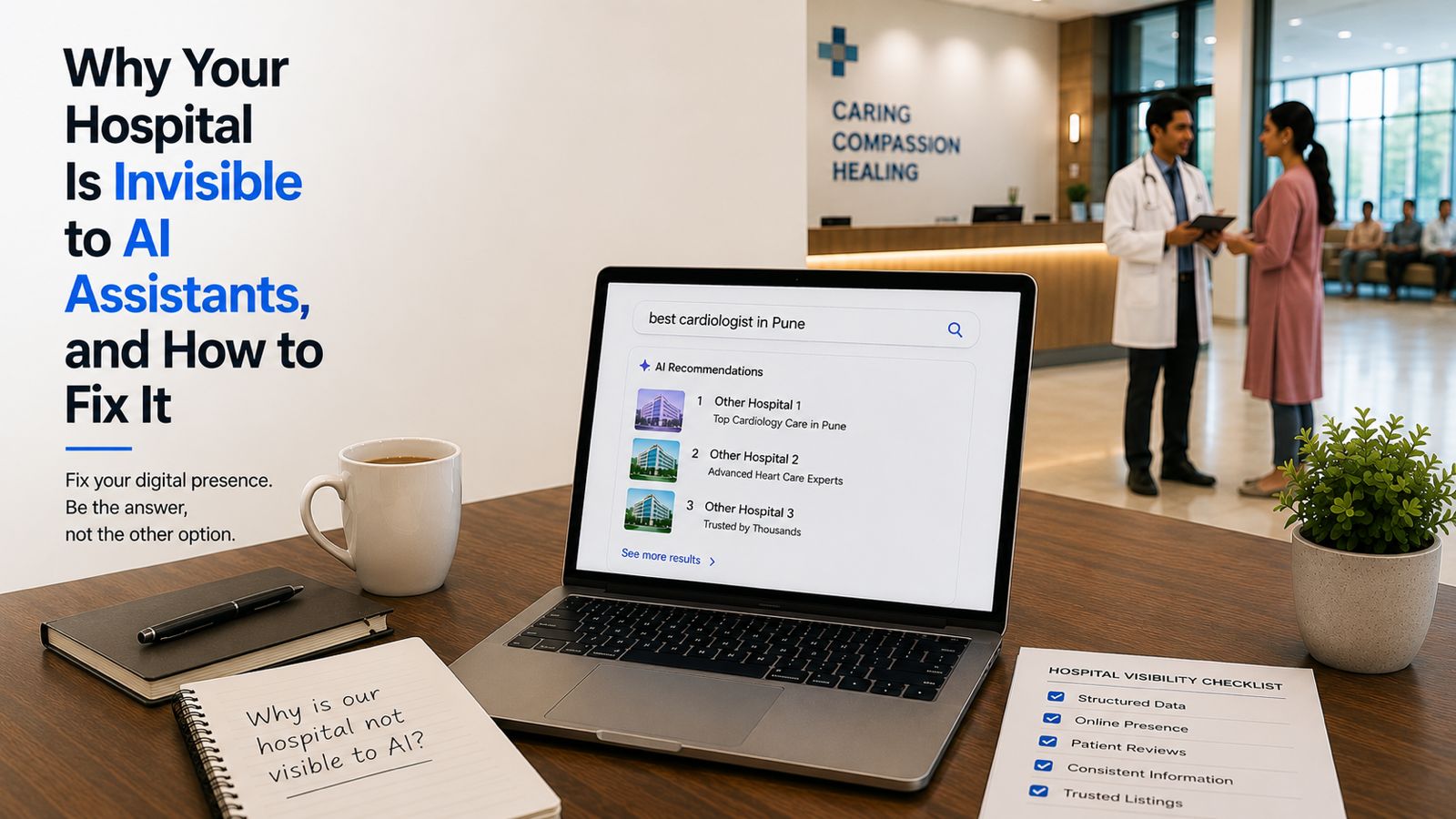
This is now a patient-acquisition problem rather than a technical curiosity. A Rock Health survey of 8,000 US adults in December 2025 found that 32% of consumers had used an AI chatbot for health information, double the 16% from a year earlier, and nearly three-quarters of those users reached for general-purpose tools like ChatGPT rather than a provider's own chatbot (Rock Health, 2025 Consumer Adoption Survey). Of ChatGPT's more than 800 million weekly users, roughly one in four submits a health-related prompt every week (eMarketer, 2025). India is on the same curve, with AI answer engines already shaping hospital patient journeys before a single click reaches a search results page (LoEstro, 2025).
Why doesn't my hospital show up when someone asks AI for a specialist?
Start with what actually happens when a patient types "best knee replacement surgeon near me" into an assistant. The model does not run a live crawl of every hospital site and rank the results. It draws on two things: what it absorbed during training, and what it can retrieve at query time from a small set of sources it considers authoritative. Your website is one input among many, and often a weak one.
Research on how these systems choose citations is now large enough to take seriously. One 2025 analysis studied 5,504,399 responses drawn from 748,425 queries across Gemini, OpenAI, and Perplexity between 25 August and 25 September 2025, and found that passages are scored on topical match, recency, authority, and clarity before they earn a mention (Daily Geo Insights, 2026). For local queries specifically, the same body of work reports that models lean on consistent representation across four or more platforms and on facts repeated across high-authority third-party sources (Search Atlas, 2025).
Read that back as a hospital. If your surgeon's name, specialty, and location are stated once on a slow-loading profile page and nowhere else in a consistent form, the model has almost nothing to anchor to. It will reach instead for the name that appears cleanly across Practo, Google Business Profile, and a dozen consistent listings, because that name looks like a verified entity and yours looks like noise.
What does an AI assistant actually read when it recommends a doctor?
It reads structure before it reads prose. A patient sees your consultant's biography as a paragraph. The model wants the same facts as labelled fields: name, medical specialty, credential, hospital affiliation, languages, and the services offered. Schema.org publishes a health and life sciences vocabulary of more than 200 types and 160 properties for exactly this purpose, including MedicalOrganization for the hospital and Physician for each consultant (Schema.org). Well-formed markup lets a search engine or assistant treat your surgeon as a distinct entity and connect that entity to your hospital, your specialties, and your location.
Beyond your own site, the model reads the wider web for agreement. Reviews and profiles on Practo, Google, JustDial, and Healthgrades are all machine-legible, and assistants cite them freely (LoEstro, 2025). Entity selection is driven by how densely and consistently your facts appear across these credible sources, with multi-platform presence standing out as one of the strongest predictors of citation (Search Atlas, 2025). A doctor who is described identically in eight places is a confident recommendation. A doctor described three different ways in three places is a risk the model routes around.
Perplexity's push into health, including connectors that pull records, wearables, and lab data into personalised answers, shows where this is heading (Perplexity, 2025). The assistant is becoming the front door to the clinical decision. The hospitals that are legible to it will be recommended, and the rest will be paraphrased away.
The five reasons hospitals go invisible
Most invisibility traces back to a short list of fixable causes.
First, no structured markup. The consultant pages carry a photo and a paragraph, and nothing tells the machine which words are the specialty and which are the credential.
Second, inconsistent facts across the web. The spelling of a doctor's name, the specialty label, and even the branch address differ between your site, Practo, and Google. Each contradiction lowers the model's confidence.
Third, thin or absent third-party presence. If your surgeons live only on your own site, the model has no corroboration, and corroboration is what it rewards.
Fourth, department-first architecture. Hospitals publish a "Cardiology" page and bury the individual cardiologists inside it. Patients ask AI for a person, so the entity that matters is the doctor, and the doctor needs a page and a record of their own.
Fifth, stale content. Recency is a scoring factor, so a profile last touched in 2021 reads as lower confidence than one that shows recent, dated activity.
None of these require a rebuild. They require someone to treat each doctor as an entity the machine must be able to verify.
How do I fix it? A practical sequence
Work in the order the model actually values.
Give every consultant their own page. One doctor, one URL, with specialty, qualifications, hospital affiliation, languages spoken, conditions treated, and location stated in plain, consistent language. This is the entity the assistant will try to match.
Add Physician and MedicalOrganization schema to those pages. Mark up the name, medicalSpecialty, credential, affiliation, and available services so the facts arrive as labelled data rather than as prose the model has to infer (Schema.org). Add MedicalOrganization markup on the hospital homepage so the doctor entities connect to the institution.
Make the facts identical everywhere. Audit Practo, Google Business Profile, JustDial, and any other listing, and force the name, specialty, and address into one canonical form. Consistency is one of the strongest levers, because it is a signal the model uses to decide whom to trust (Search Atlas, 2025).
Build corroboration off-site. Get your specialists cited in credible third-party places: verified directories, reputable health publications, and accurate profiles on the platforms assistants already read. Density across trusted sources is what converts a name from a maybe into a recommendation.
Keep it current. Date your updates, refresh consultant pages when a doctor's focus changes, and treat the profiles as living records rather than a one-time upload.
Then measure. Ask the assistants the questions your patients ask, in your city, for your specialties, and record whether you appear, whether the facts are right, and who appears instead. That last column tells you exactly which competitor has already done this work.
Where Doc Mirror fits
Doing this audit by hand across dozens of consultants and four assistants is slow, and it goes stale the week after you finish. Doc Mirror, the healthcare visibility-audit tool we built at Nextdot, runs that check for a hospital or an individual doctor: it queries how the major AI assistants describe you, flags where your facts are missing, wrong, or contradicted across sources, and shows which competing names surface for the specialties you want to own. It reads the same signals the models read, so the report maps directly onto the fixes above. Think of it as the measurement layer that tells you where to spend the effort, before you spend it.
Does Indian regulation change any of this?
It shapes how you present the facts, and it rewards the disciplined. India's medical-council conduct norms restrict how doctors can promote themselves, prohibiting self-aggrandising publicity and the boasting of cures or results, so visibility work has to stay factual and verifiable, describing qualifications and services accurately rather than making comparative or superlative claims (NMC Professional Conduct Regulations, 2023). That is a fit with what the models want, because accurate, consistent, corroborated facts are exactly what earns a citation.
The Digital Personal Data Protection Act 2023 governs patient data, so any listing, review-collection, or profile workflow must handle personal information with consent and purpose limits in mind. And as ABDM identifiers spread across the system, the direction of travel is toward verified, structured provider records, which is the same direction AI visibility already pulls you. Compliance and discoverability point the same way here.
Frequently asked questions
Why does a competitor's doctor show up in ChatGPT when mine has better credentials?
Because the assistant recommends the entity it can verify most confidently rather than the one with the strongest CV. A competitor whose name, specialty, and location repeat consistently across your site, Practo, Google, and credible third parties looks trustworthy to the model. Credentials only help once the entity is legible.
Is this the same as SEO?
It overlaps, and it is broader. Good SEO helps, because much of what assistants retrieve comes from the indexed web. AI visibility adds two demands: machine-readable structure through schema markup, and consistent corroboration of your facts across the sources models trust. A hospital can rank on Google and still be skipped by ChatGPT.
How long before changes show up in AI answers?
Retrieved sources like Google Business Profile and directory listings can reflect within days to weeks once they are consistent. Facts absorbed during model training move on the model's own update cycle, which is slower. Fix the retrievable sources first, since those move fastest.
We are a small clinic with three doctors. Is this worth it?
Yes, and it is easier at your size. Three clean consultant pages with correct schema and consistent listings across the major directories can make you the confident local answer for your specialties, precisely because most larger competitors have not done the structured work yet.
Can we do this ourselves or do we need a tool?
You can do the manual audit and the fixes yourself with patience. A tool like Doc Mirror is worth it when you have many consultants, several branches, or want a repeatable check, because it reads the same signals the assistants read and shows you where the gaps are before you spend effort closing them.