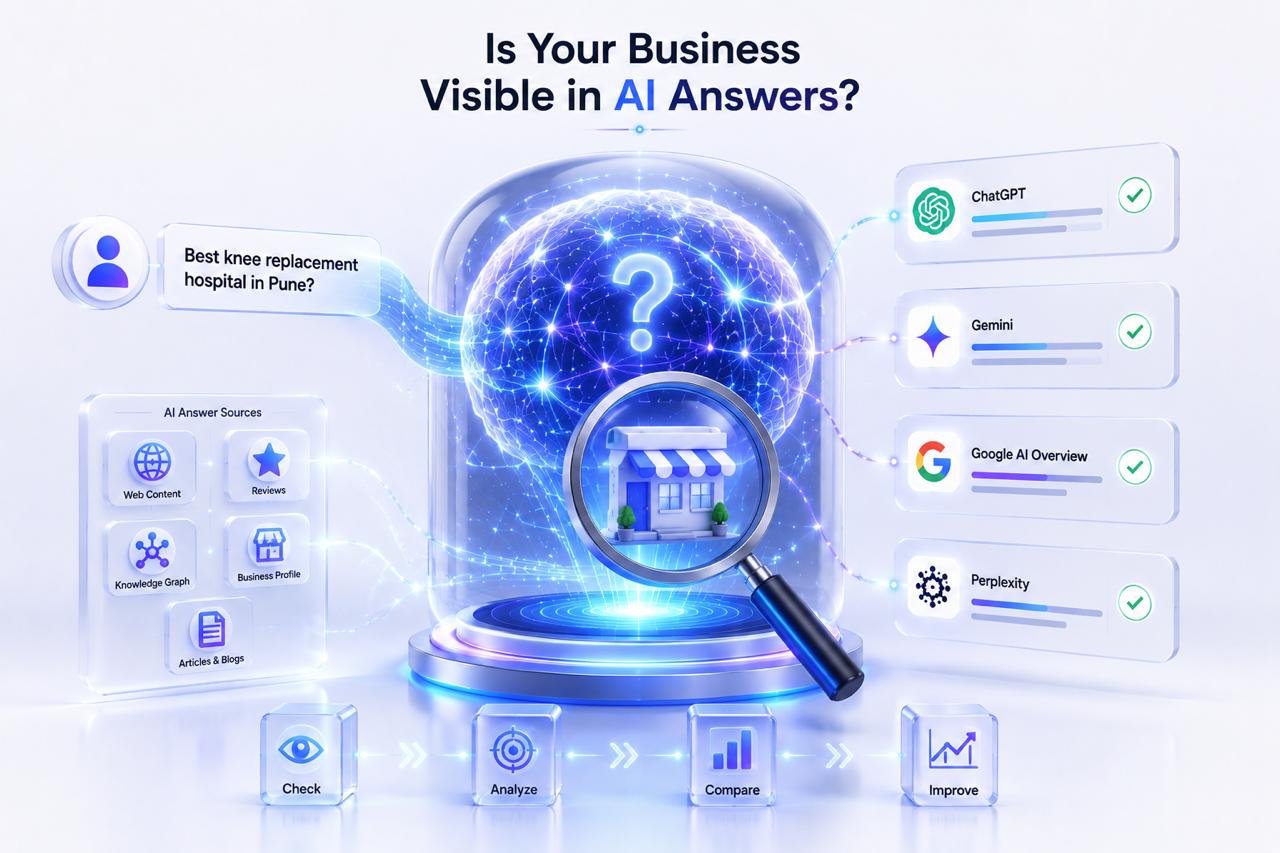
Here is why ten minutes is worth your time. By 2025, around 58.5% of United States searches ended without a click to any website (Semrush), and when a Google AI Overview appears, only about 1% of users click a link inside it (Pew Research, July 2025). The answer has become the destination. For commerce this is already measurable: across 94 ecommerce sites in 2025, traffic referred from ChatGPT converted 31% higher than non-branded organic search (Search Engine Land), and ChatGPT referrals to retailers' apps rose 28% year on year (TechCrunch, December 2025). In healthcare, more than 230 million people ask ChatGPT health questions every week (OpenAI, ChatGPT Health, January 2026). If those answers describe your category and skip your name, you are losing customers at the exact moment they decide.
Most teams have never checked. They assume that ranking on Google means appearing in AI answers. The two are related, and the gap between them is often wide. This is how you measure your own gap today.
The 10-minute method
Step 1: Write down the questions your customers actually ask (2 minutes)
Write real questions in plain language, the way a customer would type them into an assistant, rather than your brand name. Aim for five to eight.
A few examples to model yours on:
- Healthcare: "Best hospital for knee replacement in Pune", "Which cardiologist should I see for chest pain in Mumbai", "Is it safe to take ibuprofen with blood pressure medication"
- Ecommerce: "Best running shoes for flat feet under 5000", "Which air purifier is best for a small bedroom"
- B2B and enterprise: "Best CRM for a 50-person services firm in India", "Which vendor offers compliant patient-data handling for hospitals"
The test for a good question: a real buyer would ask it before they know your name. Brand-name searches do not measure AI visibility, because the engine already knows who you mean.
Step 2: Run each question across the four engines (5 minutes)
Open ChatGPT, Perplexity, Google AI Overviews (a normal Google search that returns an AI summary at the top), and Gemini. Ask each of your questions in each engine. Read the answer the way a customer would, quickly and at face value.
Perplexity is the most useful starting point, because it lists its sources openly under every answer, so you can see exactly which pages it trusted. ChatGPT and Gemini name sources less consistently, so for those, watch whether your name appears in the text of the answer itself.
Step 3: Record three things for every answer (3 minutes)
For each question, in each engine, note:
- Presence. Does your business appear in the answer at all.
- Accuracy. If you appear, are the facts correct: your specialities, your location, your prices, your hours, your claims.
- Substitution. If you do not appear, who does. Write down the competitor names that show up in your place.
That third column is the one that changes minds in a leadership meeting. Seeing a competitor named as the answer to a question you should own makes the cost concrete.
How to read your results
The check is easy. Reading it well is where the value sits. Most results fall into four patterns, and each points to a different first fix.
You are invisible. You do not appear for questions you should own. This usually means the engines cannot find clear, structured, credible information about you on the open web, or what exists is too thin to cite. The first fix is publishing clear, factual, well-structured answers to the exact questions your customers ask, on pages a machine can read. Our cornerstone guide on answer engine optimisation explains the underlying mechanics.
You appear, and the facts are wrong. This is the most urgent pattern, because a confident, incorrect answer does active damage. Wrong prices, an outdated location, a speciality you no longer offer, or a service you never provided. The fix is correcting the source information the engines pull from: your own site first, then the third-party listings and profiles that feed them.
You appear, but a competitor leads. You are in the conversation, lower than you should be. The engine has reasons to trust a rival more: clearer content, stronger corroboration across the web, or more consistent facts. The fix is to out-clarify them on the specific questions where they lead.
You are cited cleanly and correctly. Hold the position. Keep your facts current and watch the questions quarterly, because these answers shift as the engines and your competitors change.
Run this for your top questions and you will have an honest map of where you stand, which is more than most of your competitors have.
A faster route for doctors and hospitals
The manual method above works for any business. If you run a clinic or a hospital, there is a shortcut. We built the Doc Mirror to do this audit automatically for healthcare, checking a doctor's or hospital's visibility across the surfaces that feed AI answers, including search, video, and local listings, and showing the gaps on a single screen. It exists because the first reaction to "are we visible to AI" is almost always a guess, and a guess does not survive a board meeting. If you are in healthcare and want the audit without the ten minutes, it is a straightforward place to start.
What to do with what you find
A visibility check is a diagnosis, and a diagnosis only matters if you act on it. Once you know where you stand, the work is to become the clearest, most credible, most machine-readable source on the questions your customers ask. That is the discipline of answer engine optimisation, and our field guide covers how the engines decide who to cite. For healthcare specifically, our companion post on why hospitals stay invisible to AI goes deeper on the fixes.
The teams that check first, and act on what they find, will own their category inside the answer while their competitors are still counting clicks.
Frequently asked questions
How do I know if my business shows up in ChatGPT or AI search?
Run the real questions your customers ask across ChatGPT, Perplexity, Google AI Overviews, and Gemini, and record whether you appear, whether the facts are correct, and who appears instead of you. The check takes about ten minutes and needs no tools.
Is checking my Google ranking enough?
No. Ranking on Google and appearing in AI answers are related but separate. An assistant reads and synthesises sources rather than handing back a ranked list, so you can rank well and still be absent from the generated answer.
Which AI engines should I check?
Start with ChatGPT, Perplexity, Google AI Overviews, and Gemini. Perplexity is the most useful first stop because it lists its sources under every answer, so you can see which pages it trusted.
How often should I run this check?
Quarterly for most businesses, because answers shift as the engines update and competitors change their content. Check more often around major launches, price changes, or new locations.
Is there a faster way for healthcare?
Yes. The Doc Mirror runs this audit automatically for doctors and hospitals across the surfaces that feed AI answers, and shows the gaps on one screen.