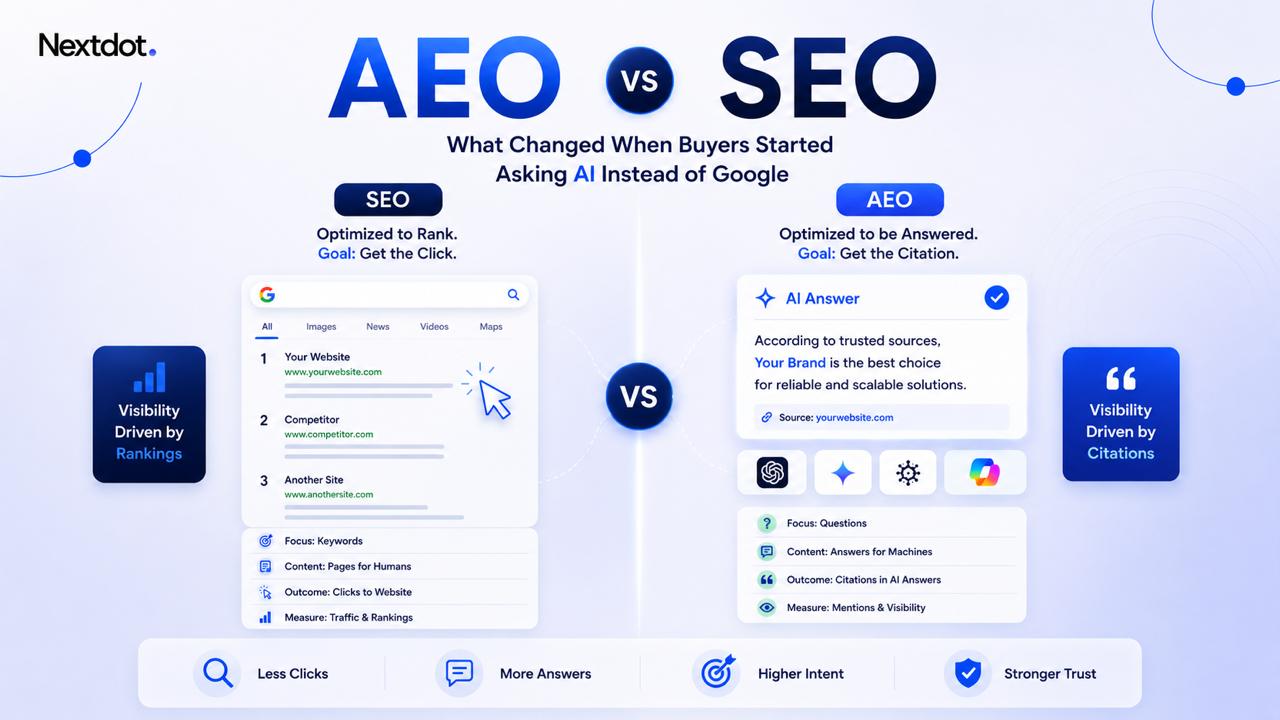
The two overlap. They share source material and much of the same technical hygiene. What moved is the goal, the unit of success, and the way you measure it.
What is SEO optimising for, and what is AEO optimising for?
SEO is a ranking game. The engine crawls pages, scores them on relevance and authority, and orders them. Your job is to land in the visible band, ideally the top three, because click-through collapses fast below that. Success is a session in your analytics: a visitor who arrived, whom you can then measure and nurture.
AEO is a retrieval-and-synthesis game. An answer engine reads a question, pulls passages from sources it trusts, and writes a single response. Your job is to be one of the passages it pulls, and to be the one it quotes verbatim when it states a fact. Success is a mention, an attribution, a correct summary of what you do, sometimes with a link and often without one. You are optimising to be the source of record for a claim, rather than a stop on a journey.
This is why the tactics diverge. SEO rewards pages built around keywords a person might type. AEO rewards pages built around questions a person might ask, answered cleanly enough that a model can lift the answer without ambiguity. A machine that is assembling a reply prefers a direct, self-contained statement it can trust over a page engineered to keep a human scrolling.
Why did the click stop being the point?
Because the click was already leaking before generative AI arrived. In 2024, 58.5% of US Google searches ended without a single click to the open web, according to SparkToro's zero-click study led by Rand Fishkin using Datos clickstream data (Search Engine Land, June 2024). Answer boxes, knowledge panels, and featured snippets were already satisfying the query on the results page. Buyers had been getting answers without visiting anyone for years.
Generative assistants extended that behaviour to its conclusion. Gartner predicted that traditional search engine volume would fall 25% by 2026 as chatbots and virtual agents absorb queries that used to go to search (Gartner, February 2024). The scale is real: ChatGPT reached roughly 900 million weekly active users by February 2026, more than double a year earlier (TechCrunch, February 2026). A meaningful share of research that once began in a search bar now begins in a chat window.
So the click survived in a thinner form. It became rarer and, for those who still measure only clicks, invisible. Your brand can be discussed, compared, and recommended inside an assistant's answer while your analytics show nothing, because no session was created. Absence from your dashboard no longer means absence from the buyer's decision.
Does the click that survives matter more or less?
When a click does come from an AI answer, early evidence says it is worth more. Semrush's June 2025 study of more than 500 high-value topics found that visitors arriving from ChatGPT, Perplexity, or AI Overviews convert at roughly 4.4 times the rate of standard organic search traffic (Semrush, June 2025). Reported multiples vary across studies and the samples are still small, yet the direction is consistent. The intuition holds up: the assistant has already done the filtering and the shortlisting, so the person who clicks through is closer to a decision than a browser scanning a results page. The volume is still small, but the intent is concentrated.
That reframes the trade. SEO chased large volumes of moderately qualified sessions. AEO chases a smaller number of highly qualified ones, plus the harder-to-count value of simply being named as the answer. If you are a hospital and an assistant recommends you when a patient asks who does paediatric cardiac surgery in their city, the recommendation itself has value even if the patient never touches your website first.
What does AEO ask you to do that SEO did not?
Most of the groundwork overlaps. Crawlable pages, clean structure, fast load, and structured data all still matter, and schema markup arguably matters more because it hands a machine unambiguous facts. On top of that shared base, AEO adds a few practices that SEO treated as optional.
Write for questions rather than keywords. Give each important question its own clear heading and answer it completely in the first hundred words beneath it, so a model can extract a clean passage. State your facts plainly and consistently everywhere they appear, because an assistant that finds three different versions of your service list will trust none of them. Keep the machine-readable ground truth about your organisation, your name, locations, specialties, and credentials, accurate across your own site and the third-party sources models lean on. And check whether the assistants actually describe you correctly, because unlike a ranking you can look up, an AI answer is generated fresh each time and can be confidently wrong about you.
That last point is where a lot of teams get caught. You can rank well and still have an assistant tell a buyer you do not offer a service you built your practice around. This is the gap our own audit tool, Doc Mirror, was built to surface for doctors and hospitals: what the major assistants say when someone asks about you, and where those descriptions drift from reality.
Does AEO matter more in regulated industries like healthcare?
It matters more, and it is harder. In healthcare an incorrect AI answer means a patient acting on wrong information about a symptom, a medicine, or a provider, which carries far more weight than a lost lead. Indian context tightens this further. The DPDP Act 2023 governs how patient data is handled, the ABDM framework shapes how health information is structured and shared, and NMC guidelines constrain how doctors may advertise and present themselves. AEO in this setting has to be compliance-aware by design: you want assistants to describe your services and credentials accurately without your content straying into claims a regulator would question. Getting quoted correctly and getting quoted safely are the same task here.
For marketing leaders the practical move is to run both tracks with clear eyes. Keep the SEO work that still earns qualified sessions. Add the AEO work that decides whether you exist inside the answers buyers now trust. Measure both: rankings and sessions on one side, citations and answer accuracy on the other. The organisations that treat these as one discipline with two scoreboards will be the ones an assistant names when a buyer asks.
Frequently asked questions
What is the difference between AEO and SEO in one sentence?
SEO optimises your pages to rank on a search results list and earn a click, while AEO optimises your content to be cited inside the single answer an AI assistant generates, whether or not a click follows.
Does AEO replace SEO?
No. They share technical foundations and source content, and most sites should run both. SEO still earns qualified sessions from traditional search, and AEO decides whether you appear inside AI-generated answers.
How do I know if my business appears in AI answers?
Ask the major assistants the questions your buyers ask and read what they return about you. Because answers are generated fresh each time, you have to test them directly. Audit tools such as Doc Mirror do this systematically for doctors and hospitals.
Why do clicks from AI assistants convert better?
The assistant has already filtered and shortlisted before the person clicks, so the visitor arrives closer to a decision. Multiple 2025 to 2026 studies report AI-referred traffic converting several times higher than standard organic search, though sample sizes remain small.
What should a healthcare brand do first?
Confirm that the machine-readable facts about your services, locations, and credentials are accurate and consistent everywhere, then check what assistants actually say about you, keeping everything within DPDP, ABDM, and NMC requirements.