Why is AI search different from the SEO you already run?
The behaviour has already moved. Rock Health's 2025 Consumer Adoption of Digital Health survey found 32% of respondents used an AI chatbot to find health information, up from 16% a year earlier (Fierce Healthcare, 2025). OpenAI has said more than 230 million people ask health and wellness questions on ChatGPT every week, and it launched a dedicated ChatGPT Health experience on January 7, 2026 (TechCrunch, 2026).
The supply side has moved with it. Google now shows an AI Overview for roughly 89% of healthcare-related queries, up from about 59% two years earlier, and for treatment and procedure queries that figure reaches 100%, up from about 45% in 2023 (BrightEdge, 2025). When an AI Overview appears, the click almost never follows: zero-click rates climb to around 83% (Semrush, 2025). Across all US searches, 58.5% ended without a click in 2025 (Semrush, 2025).
Read those two shifts together. Your patients are asking machines, and the machines are answering without sending anyone to your site. A page that ranks second on Google can now be invisible in the answer a patient actually reads. Ranking and being cited are two different games, and healthcare is one of the verticals where the gap is widest.
What actually gets a healthcare brand cited in AI answers?
The ranking signals here differ from the backlink math that ran SEO for two decades. In an Ahrefs study of 75,000 brands, brand mentions correlate roughly three times more strongly with getting cited than backlinks do, around 0.66 versus 0.22 (Omnibound, 2026). Language models learn from raw text, so when independent sources consistently describe your hospital or your molecule in the same terms, the model treats you as a known, credible entity worth naming.
Three practical implications for a hospital CMO or a pharma marketing lead.
First, earned coverage compounds. Content distributed across a range of reputable publications can increase AI citations by up to 325% compared with publishing only on your own domain (Omnibound, 2026). Medical association pages, credible health portals, doctor directories, and genuine press coverage now feed the model directly. A single owned microsite, however polished, is a weak signal on its own.
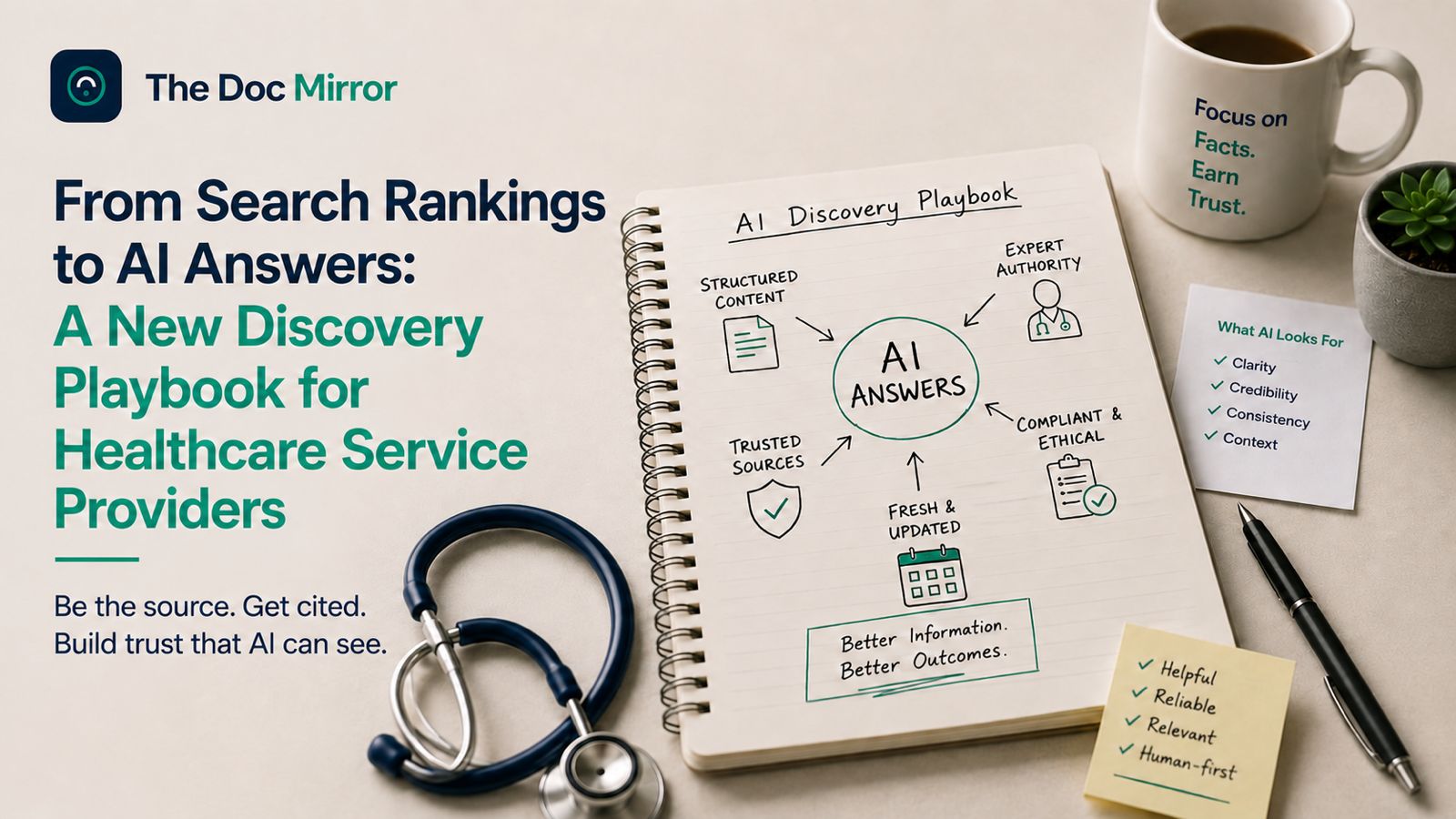
Second, freshness is a ranking factor. Around 85% of AI Overview citations come from content published within the last two years, and recently updated pages appear far more often in AI answers (Omnibound, 2026). A department page last touched in 2021 reads as stale to the model. Treatment protocols, consultant lists, and FAQ pages need a maintenance calendar.
Third, structure is legible to machines. Clear question-and-answer formatting, defined clinical terms, named authors with credentials, and schema markup all make a page easier for a model to lift a clean sentence from. Write the way a patient asks: "What is the recovery time after a knee replacement?" then answer it in the first two lines.
How do NMC and DPDP change the playbook in India?
This is where healthcare marketing splits from every other category, and it works in your favour. Most brands cannot buy their way into AI answers even if they wanted to. OpenAI currently excludes healthcare, prescription drugs, and clinical care providers from its ad inventory during its test period (WebFX, 2026; OpenAI Ad Policies, 2026). So the AI answer layer is close to a pure earned-visibility channel for hospitals and pharma. Your competitor cannot outspend you into a citation. They can only out-publish and out-earn you.
The NMC Code of Ethics sets the guardrails on what you publish. Educational content, factual credentials, and compliant patient information are permitted. Outcome claims, comparative superiority ("the best cardiac unit in the region"), and unverified testimonials are prohibited. The useful part: the AI answer layer rewards exactly the content NMC allows. Models prefer sober, factual, well-sourced writing and tend to distrust promotional superlatives. Compliance and citability point in the same direction here.
The DPDP Act, 2023 adds the data discipline. Any AI you use to draft, personalise, or automate patient-facing content has to respect consent and purpose limitation, and patient data cannot leak into training or targeting without a lawful basis. Practically, keep a human clinical reviewer on every AI-assisted draft, and keep patient information out of the marketing stack unless you have documented consent for that specific use.
What should a healthcare marketing team actually do first?
Start with measurement, because most teams have never checked. Ask the questions your patients ask, across ChatGPT, Perplexity, Gemini, and Google AI Overviews: your specialties, your city, your named consultants, your competitors. Record who gets cited and who is absent. This is a share-of-voice audit for the AI answer layer, and it usually surprises the CMO who assumed a strong Google rank meant strong AI presence.
From there, a sequence that holds up in practice:
- Fix the source pages. Every department, procedure, and consultant needs a factual, dated, structured page that answers the real patient question in the opening lines.
- Earn third-party mentions. Prioritise medical directories, credible health publications, and authored clinical content on platforms the models already trust, since off-domain coverage moves the needle harder than owned pages.
- Keep it alive. Put source pages on a review cadence so freshness works for you rather than against you.
- Instrument referral traffic. AI-referred sessions grew 527% between January and May 2025, and that traffic tends to convert better than generic organic (Digiday, 2025). Tag it so you can see the pipeline forming.
At Nextdot we built Doc Mirror partly for the first step: an AI-visibility audit that shows a hospital or a doctor exactly how they surface across AI assistants, and where the gaps and compliance risks sit. That is the soft pitch. The larger point stands on its own. Discovery in healthcare has moved from the ranked list to the synthesised answer, and the brands that treat AI citation as a measurable, compliance-aware marketing discipline in 2026 will own the questions their patients are already asking a machine.
Frequently asked questions
Should healthcare brands stop doing SEO?
No. Solid technical SEO, structured content, and authority still feed AI systems, because models draw heavily on the same well-organised web pages that rank. The shift is in the goal: optimise the page to be quoted in an answer rather than only to hold a position in a list.
Can we pay to appear in ChatGPT or AI Overviews?
Largely not, in healthcare. OpenAI currently excludes clinical care providers and prescription drugs from its ad test, and AI Overview citations are earned rather than bought. This makes organic AI visibility the channel that returns the most, and it removes the option to outspend rivals into an answer.
Is AI-driven discovery NMC compliant?
The content you publish must follow NMC rules: factual credentials and education are allowed, while outcome claims and unverified testimonials are prohibited. The reassuring part is that AI answer systems favour the same factual, non-promotional tone that NMC requires, so compliant content is also more citable.
How do we measure success if patients never click?
Track citation frequency and share of voice inside AI answers for your priority queries, alongside AI-referral sessions and downstream conversions. Rankings alone no longer predict how many patients actually see you.
How does DPDP 2023 affect AI marketing?
Patient data used in any AI-assisted personalisation or automation needs consent and a defined purpose, and it cannot flow into training or targeting without a lawful basis. Keep a clinical reviewer in the loop and keep patient records out of the marketing stack unless consent covers that specific use.