Can doctors legally advertise in India?
No. Soliciting patients is treated as professional misconduct. Clause 6.1 of the 2002 Regulations states plainly that "soliciting of patients directly or indirectly, by a physician, by a group of physicians or by institutions or organisations is unethical." The same clause treats printing your own photograph on a letterhead or signboard as self-advertisement and unethical conduct. Sketches and diagrams of human anatomy are allowed. Your face marketed as a brand is not.
The National Medical Commission tried to modernise this. Its Registered Medical Practitioner (Professional Conduct) Regulations, 2023 were notified in the Gazette on 2 August 2023 and spelled out social-media conduct in detail (per the NMC notification and Drishti IAS, 2023). Those rules were held in abeyance on 23 August 2023, and the NMC re-adopted the 2002 Regulations with immediate effect (NMC, August 2023). So the 2023 draft is instructive about where the regulator wants to go, and the 2002 code is what a state medical council will actually act on today.
What the 2023 draft made explicit is worth reading even in abeyance, because it signals intent. It prohibited requesting, sharing, or displaying patient testimonials and reviews. It barred posting before-and-after images of cured patients or advertising success rates. It treated inviting patients, promoting special offers, and using emotional case stories as solicitation. Under the proposed enforcement, a violation could draw a warning or suspension of licence for 30 days (The Print and Drishti IAS, 2023). Treat that list as the boundary regardless of the current abeyance, because most of it simply restates the spirit of Clause 6.1.
What are doctors actually allowed to publish?
A good deal, as long as it is factual and does not solicit. The 2023 draft codified a set of permitted formal announcements that a doctor may make in print, electronic, or social media within three months of the event: starting practice, changing the type of practice, changing address, temporary absence from duty, resumption of practice, succeeding to another practice, and a public declaration of charges (NMC RMP Regulations draft, 2023). These are announcements of fact, and they are the clearest signal the regulator has given about acceptable disclosure.
Institutions get similar room. A hospital or clinic may publish its name, the type of patients it treats, the categories of doctors and staff and their training, the facilities available, and the fees. Notice the pattern. Everything permitted is verifiable and descriptive. Everything prohibited is persuasive: testimonials, success rates, superlatives, emotional appeals, and any framing designed to pull a patient toward you rather than inform a patient who is already looking.
That distinction is the whole game for AI discovery. Answer engines reward exactly the material you are allowed to publish, and they penalise, or simply cannot verify, the material you are barred from publishing. Compliance and discoverability point in the same direction here, which is a rare and useful alignment.
Why does AI discovery matter for a clinic now?
Because a growing share of patients start their search inside an AI assistant rather than a list of blue links. In Rock Health's 2025 Consumer Adoption of Digital Health Survey, 32 percent of respondents said they had used AI chatbots to find health information, with ChatGPT and Gemini the most-used tools at 23 percent and 15 percent respectively (Rock Health, 2025). That survey covered US respondents, so read it as a direction of travel rather than an Indian figure. The behaviour is arriving in India through the same consumer apps.
When a patient asks an assistant a clinical-adjacent question, the model composes an answer from what it can find and verify about practitioners and facilities. If your public footprint is thin, inconsistent, or contradictory, one of three things happens. The assistant omits you. The assistant describes you inaccurately. Or the assistant surfaces a competitor whose facts are cleaner. None of those outcomes involves advertising, and none of them is something you can fix by spending on ads you are not permitted to run anyway.
How does a doctor get found by AI without advertising?
Start from a principle: you are structuring facts rather than running a campaign. The work is compliance-aware by design, and it is closer to record-keeping than to marketing.
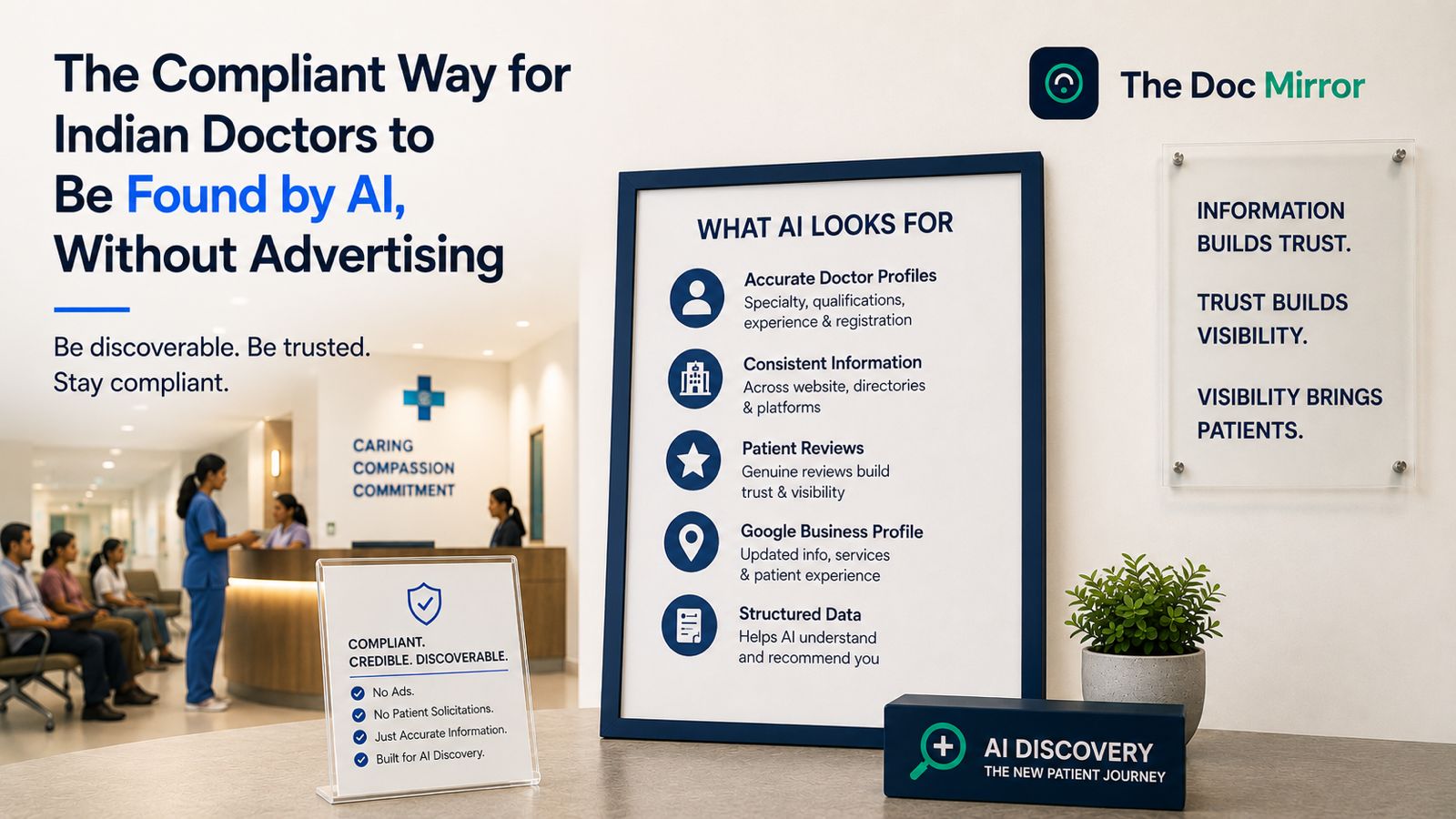
Fix your identity data first. Your name, qualifications, registration number, specialty, languages spoken, clinic address, and consultation hours should be identical everywhere they appear: your own site, hospital directory pages, Google Business Profile, and practitioner listings. Answer engines lower confidence when the same entity carries conflicting facts across sources, and low confidence means the model quietly leaves you out.
Publish factual, structured content that answers real patient questions. A page that explains what a specific procedure involves, who is a candidate, what recovery looks like, and what it costs is educational, verifiable, and squarely inside Clause 6.1. It reads as information a patient was already seeking. It is also precisely the kind of content an answer engine can extract and cite. Write in plain language, mark it up with structured data, and keep claims verifiable and free of superlatives.
Use the permitted announcements as they are meant to be used. If you have started practice, changed address, or set out your consultation charges, state those facts clearly and let them propagate. This is disclosure the regulator has explicitly allowed, and it doubles as the ground truth an assistant needs.
Keep testimonials and outcome claims out entirely. This is where clinics most often cross the line while chasing visibility. Star ratings you display yourself, curated patient stories, cure rates, and before-and-after galleries all read as solicitation, and the 2023 draft named them directly. They also add little to how an answer engine understands you, because a model treats self-published praise as low-trust. You lose on ethics and gain nothing on discovery.
Where do DPDP and ABDM fit in?
Two Indian frameworks shape what you can safely do with patient data while building visibility. The Digital Personal Data Protection Act, 2023 governs how you collect and process personal data, which matters the moment you think about publishing anything that touches a patient. Consent under DPDP does not convert a testimonial into compliant advertising, because the NMC bar on solicitation is a separate obligation from the data-protection one. You have to clear both. The Ayushman Bharat Digital Mission (ABDM) is building the identity and records layer for Indian healthcare, and being correctly represented there is part of being an accurate, verifiable entity that AI systems can trust. The safe posture is straightforward: publish your own professional facts freely, and treat every piece of patient-linked information as something you cannot publish without clearing both the NMC conduct rules and DPDP consent.
What should a clinic do first?
See yourself the way an assistant currently does. Ask ChatGPT, Gemini, and a couple of others who you are, what you specialise in, and where you practise, and read the answers as a patient would. Most doctors are surprised, because the model is often confidently wrong: outdated address, wrong hospital affiliation, a specialty that lapsed years ago, or silence.
That audit is the starting point, and it is what Doc Mirror does for doctors and hospitals: it checks how AI assistants describe you today and flags where the public record is thin, stale, or contradictory, so you can correct facts rather than buy attention. At Nextdot we built it because the fix for most practitioners is a clean, consistent, verifiable set of facts that an answer engine can stand behind, assembled entirely inside the line Clause 6.1 draws, rather than a marketing budget.
Being found by AI, done properly, is an exercise in accuracy. The rules that stop you from advertising also happen to describe the exact material that makes you discoverable. Get your facts right, keep persuasion out, and let the answer engine do the rest.
Frequently asked questions
Can an Indian doctor run Google or Instagram ads for their clinic?
Paid promotion that solicits patients falls foul of Clause 6.1 of the 2002 Regulations, which treats direct and indirect solicitation as unethical. Factual announcements the regulator permits, such as a change of address or a public declaration of charges, are a different category from persuasive advertising.
Are patient reviews and testimonials allowed?
The NMC's 2023 draft explicitly prohibited requesting, sharing, or displaying patient testimonials and reviews, and this restates the spirit of the 2002 code. Displaying curated testimonials or outcome claims on your own site or social media reads as solicitation. Independent third-party reviews you neither request nor control sit in a different position, though you should not amplify them as promotion.
Is the NMC 2023 Professional Conduct code currently in force?
No. The 2023 Regulations were held in abeyance on 23 August 2023, and the NMC re-adopted the Indian Medical Council (Professional Conduct, Etiquette and Ethics) Regulations, 2002. State medical councils act on the 2002 code today, so treat it as the operative rule.
Does being cited by an AI assistant count as advertising?
An AI assistant answering a patient's query from public facts is closer to a directory than to an advertisement. The compliant approach is to control accuracy rather than persuasion: publish verifiable professional facts, and avoid testimonials, success rates, and superlatives that would read as solicitation whether a human or a model surfaces them.
What is the fastest first step to becoming discoverable?
Audit what AI assistants say about you now, then correct your identity data so your name, registration, specialty, and clinic details match across every public source. Consistent, verifiable facts raise a model's confidence and are entirely within the conduct rules.