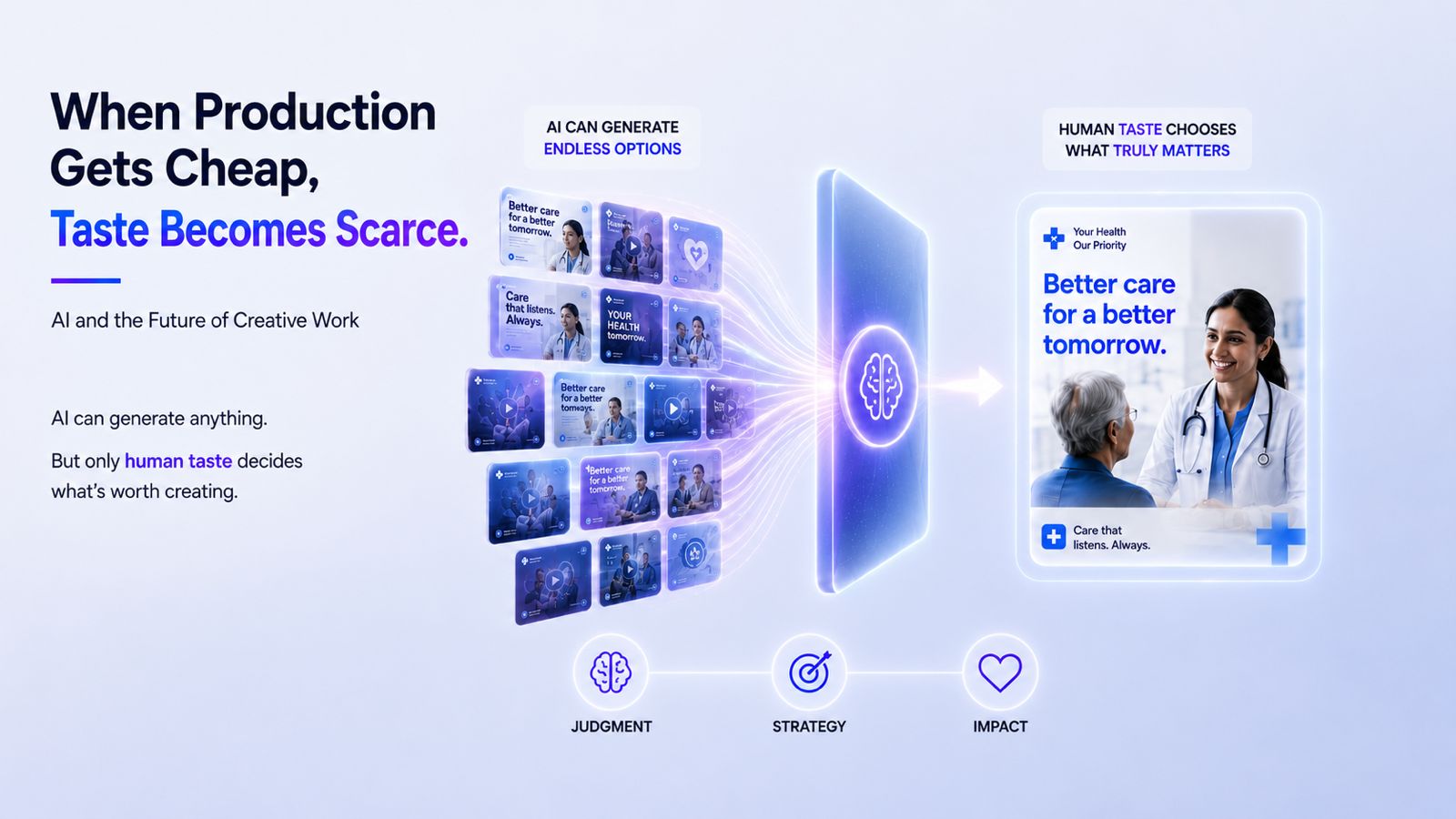
That is the real story behind the question everyone keeps asking. Will AI replace creatives? The honest answer is that it is already replacing a specific kind of creative work, and pretending otherwise helps no one. The more useful question for any CMO or creative leader is which work loses its value, which work gains it, and where the people and budgets should move.
The part that is genuinely going away
For a long time, a large share of creative work was production. Resizing a campaign into forty formats. Cutting a long video into a dozen social edits. Drafting the tenth variation of a headline. Building the static that the brief already described. This work needed skilled hands, took real time, and cost real money, so it carried a premium.
That premium is collapsing. By some industry estimates, a sixty-second spot that once cost tens of thousands of dollars and took close to two weeks can now be produced for a few hundred dollars in well under an hour. When the cost and time of producing an asset fall by an order of magnitude, the economic value of being the person who produces it falls with them.
So the honest part first. Roles that were mostly execution are under real pressure. The studio that sold volume, the junior seat that existed to push pixels through a queue, the agency line item that billed hours for mechanical versioning: these do not survive a world where the machine does the mechanical part in minutes. Anyone telling creative teams that nothing will change is selling comfort, not truth. Some jobs, as they are defined today, are going.
The part that becomes more valuable, not less
Here is what abundance does. When anything can be produced, the scarce input stops being production and becomes judgment. Someone still has to decide what is worth making. Someone has to look at the thousand options a model can generate and know which one is right for this brand, this audience, this moment. Someone has to write the brief that points the machine at the correct problem, and someone has to kill the ninety-five versions that are competent and forgettable.
That capacity has a name, and it is taste. Taste is knowing what good looks like before the data confirms it, understanding why one execution will land with a specific audience and another will slide past, and holding a clear point of view about a brand when the tools will happily generate anything you ask. A model gives you the average of everything it has seen. Taste gives you the specific, deliberate, slightly surprising right answer. The first is now abundant. The second is rarer than ever, and it is about to be paid like it.
Taste resists automation for a reason that matters. It is contextual and trained on outcomes. It comes from knowing a particular brand, a particular market, and what actually moved a real audience last quarter, rather than from the general internet. A tool can produce the asset. It cannot decide, on your behalf and in your context, whether the asset deserves to exist.
What this means for creative careers
The transition is real, and it is uneven. The creatives who rise in the next few years will be the ones who shift from being the hands to being the judgment: directing the work, editing the machine's output, sharpening the brief, and reading performance well enough to know what to make more of. The ones who define themselves only by the production task they own today will have the hardest time, and saying so plainly is more respectful than pretending the ground is not moving.
The encouraging part is that the ceiling rises. A single person with strong taste and good tools can now direct the output that used to need a department, and direct it toward better work, because the time once spent on mechanical production goes back into thinking, choosing, and refining. The job becomes more creative, not less, for the people who make the shift.
What this means for CMOs
If production is no longer the scarce thing, then paying for volume is paying for the wrong thing. The old model, where an agency bolts AI onto its existing delivery and sells you more outputs faster, misreads where the value moved. More average assets, produced more cheaply, is not an advantage when your competitor can produce the same flood. The advantage is taste applied to your brand, close to your performance data, often enough to compound.
That points to a different shape of creative partner: a small unit of people with real judgment, embedded close to your brand and your numbers, using AI to produce at scale while spending their human hours on the choices that decide whether the work performs. This is the logic behind how we built Nextdot's AI Creative Pod, a unit that pairs human taste with AI production and learns from your real performance data, so the output gets sharper each month rather than merely faster. The point is not the volume it can make. The point is the judgment it applies to what is worth making.
The work that remains is the work that always mattered
Strip out the anxiety and the technology, and the conclusion is almost old-fashioned. When production was expensive, you could hide mediocre ideas behind expensive execution. When production is cheap, there is nowhere to hide. The idea, the judgment, and the taste are exposed, and they are all that separate work that performs from work that fills a feed.
Will AI replace creatives? It will replace the parts of creative work that were never really creative, and it will make taste the most valuable thing a creative person or a brand can own. The future of this craft belongs to the people who can tell what is worth making. That has always been the job. AI just removed everything that used to disguise it.
Frequently asked questions
Will AI replace creatives?
It is already replacing production and execution work, such as mechanical versioning, resizing, and routine drafting, which is becoming fast and cheap. It is not replacing judgment, direction, and taste, which become more valuable as production becomes abundant. Creatives who move from execution to judgment gain; those defined only by execution face real pressure.
What creative skills become more valuable because of AI?
Taste and judgment: knowing what is worth making, writing a sharp brief, editing and directing AI output, holding a clear brand point of view, and reading performance data to decide what to produce more of. These are contextual, outcome-trained skills that models do not provide on their own.
What should CMOs do differently?
Stop buying creative volume, since volume is now cheap, and start buying taste applied close to your brand and performance data. The useful partner is a small, embedded unit that uses AI to produce at scale while spending its human time on the choices that decide whether the work performs.
Does cheaper production mean lower quality?
Cheaper production raises the floor and exposes the ceiling. Anyone can now make a competent asset, which means competence no longer differentiates. Quality and distinctiveness come from the judgment applied rather than from the cost of producing the asset.