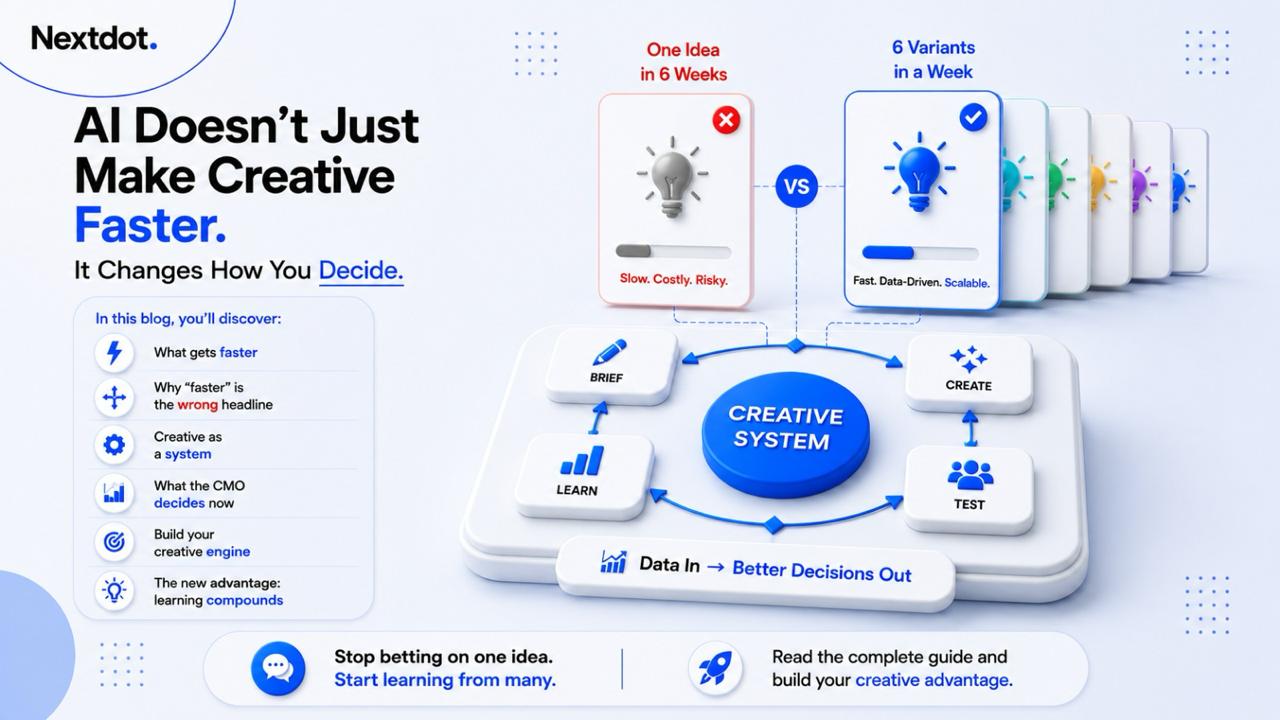
The real shift AI brings to creative is a change in what a decision costs. When a variant took two weeks and a five-figure production bill to make, you argued about the idea in a room and shipped one version. When a variant takes an afternoon, you ship six, put them in front of real audiences, and let the numbers tell you which instinct was right. Speed is the visible part. The decision model underneath is what changes your marketing. AI moves creative from a series of expensive bets to a system that produces evidence, and it rewards teams built to read that evidence rather than defend a single hero idea.
What actually gets faster, and what does not
The gains are real and they are specific. Gartner's 2025 CMO Spend Survey found marketers report generative AI returning value mainly through improved time efficiency (49 percent), cost efficiency (40 percent), and capacity to produce more content or handle more business (27 percent) (Gartner, May 2025). In practice that shows up as production collapsing. The British Council adapted a single campaign into more than 1,000 ad variations across seven languages, reporting a 70 percent cut in content creation cost and a 50 percent reduction in turnaround time (Creatopy customer story, 2025).
What speeds up is the middle of the process: drafting, resizing, versioning, localisation, the second and third and twentieth cut of an idea that already exists. What does not speed up is the part that decides whether the idea is worth cutting at all. The brief still takes as long. Taste still takes as long. Reading a test result honestly still takes as long. So the honest description of the change is this: the cost of trying a direction dropped close to zero, while the cost of choosing directions stayed exactly where it was. That asymmetry is the whole story, and it is why most teams get the speed and miss the value.
Why "faster" is the wrong headline
Faster production, on its own, buys you more mediocre work sooner. That is the trap. Marketing budgets have been flat for two years running, sitting at 7.7 percent of company revenue in Gartner's 2025 survey, with 59 percent of CMOs saying they lack the budget to execute their strategy (Gartner, May 2025). By 2026, CMOs were putting 15.3 percent of the marketing budget into AI, and yet only 30 percent said they were ready to scale it (Gartner, May 2026). The money is moving. The operating model, for most teams, is not.
The interesting change sits in the sequence of decisions rather than in output volume. The old model asked one question up front, "which idea is best," answered it with senior judgement, and committed. The systemic model asks a narrower question, "which of these directions is worth scaling," and answers it with data from the market a week later. You still need the judgement. You use it to pick the six directions worth testing and to read what comes back, rather than to place a single six-week bet you cannot revise.
Creative as a system: the parts that matter
A system has inputs, a production loop, and a feedback loop. When creative runs as a system, each part has an owner and a measurable output.
The input is the brief. When production was scarce, a loose brief was survivable because you only made one thing and a senior hand corrected it along the way. When you are generating six or sixty variants, an ambiguous brief multiplies the ambiguity across every one of them. The brief becomes the single most decisive document in the process, which is why we treat it as the place a campaign is won or lost.
The production loop is where AI earns its keep. Structured prompts, brand-trained models, and a human editor turning a signed-off direction into many compliant, on-brand variants. Gartner has been blunt that this is a training problem: marketers who want on-brand output have to invest in teaching the model their brand rather than expecting it off the shelf (Gartner, March 2025). Production-grade output comes from that discipline rather than from a better prompt typed in a hurry.
The feedback loop is the part teams skip, and it is the part that pays. Six variants are only worth making if something reads the results and feeds the winners back into the next brief. Without that, you have a faster way to guess. With it, every cycle sharpens the next, and the advantage compounds. Deloitte has argued that for high-performing marketers the edge now comes from how fast they turn data into personalised creative (Deloitte, 2025).
What the CMO actually decides now
Your decisions change shape. Three of them matter most.
First, you decide the portfolio rather than the piece. Instead of approving one execution, you approve a spread of directions worth testing and a budget for finding out. That is a different muscle. It asks you to hold several plausible answers at once and stay honest about which you personally prefer versus which the data supports.
Second, you decide the guardrails once, so the loop can run without you. What is on-brand, what claims are allowed, what a channel needs. In regulated categories this is not optional. For our pharma and healthcare clients, every variant has to sit inside NMC and advertising norms and, where personal data is involved, DPDP Act 2023 obligations. A compliance-aware production loop, where the rules are encoded and checked before anything ships, is the only version of speed that survives contact with a regulator.
Third, you decide what human attention is for. When production gets cheap, taste becomes the scarce input. The senior time you used to spend pushing pixels moves to writing sharper briefs, judging test results, and killing directions early. That reallocation, more than any tool, is what separates teams that get value from teams that just get volume.
The volume that actually means something
There is a benchmark we hold our own Creative Pod to: 250 production-grade creatives a month, on brand and channel-ready, for a single client engagement. The number is worth stating plainly because it makes the point about systems concrete. You do not reach 250 by working faster. You reach it by running a real loop, a tight brief, a trained production stage, and a feedback stage that decides what to make next, with a prompt engineer and an editor inside the pod rather than a queue of one-off requests. Volume is the output of the system. It is never the goal.
The counterintuitive part for most marketing leaders is that a well-run system makes the creative more distinctive rather than blander. When variants are cheap, the safe, average execution loses its cost advantage, because you can afford to test the strange idea alongside the safe one and let the audience settle the argument. And one caution worth carrying: 78 percent of consumers told Gartner that clear labelling of AI-generated content matters to their trust (Gartner consumer survey, October to November 2025). Speed that erodes trust is a loan against the brand, and it comes due.
Frequently asked questions
Does AI creative reduce the need for senior marketers?
It reallocates them. The hours saved on production move to briefing, judgement, and reading test results. Those are senior tasks, and a system starved of that attention produces more work of lower quality.
How much faster is AI creative production, realistically?
Published cases report turnaround cuts around 50 percent and cost cuts of 70 percent or more on high-volume, variant-heavy work (Creatopy customer story, 2025). The gains concentrate in versioning, localisation, and resizing. Strategy and idea selection do not compress.
Is high-volume AI creative safe in regulated industries?
Only with a compliance-aware loop. Claims, disclaimers, and data handling under DPDP Act 2023 and sector norms have to be encoded and checked before publishing. Volume without that control raises risk in proportion to output.
What is the difference between more content and creative as a system?
More content is faster guessing. A system adds a feedback loop that reads results and shapes the next brief, so quality compounds over cycles instead of flattening.
What does a realistic monthly creative output look like?
Nextdot's Creative Pod works to a benchmark of around 250 production-grade, channel-ready creatives a month per engagement, produced through a structured brief-to-feedback loop rather than ad hoc requests.