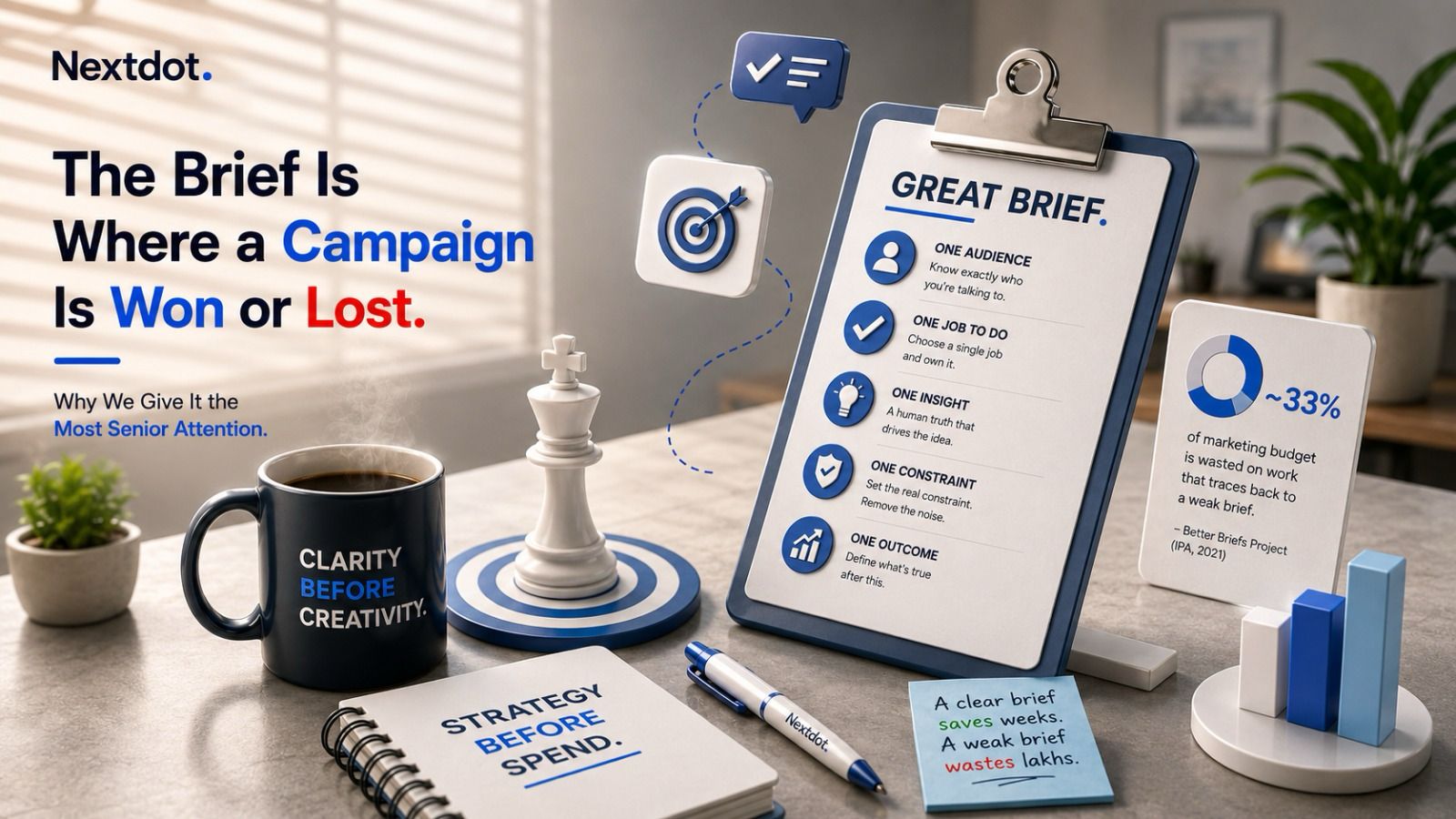
A good creative brief is a decision, written down. It names one audience, one job the work has to do, one thing that has to be true after someone sees the work, and the single constraint that everything else bends around. It matters because roughly a third of marketing budget is wasted on work that traces back to a weak brief, according to the Better Briefs Project (IPA, 2021). Everything downstream, the concepts, the media, the production, inherits the clarity or the confusion of that one page. This post explains what separates a brief that produces work from one that produces revisions, and why the most experienced person in the room should write it rather than merely review it.
Why does the brief decide the outcome before any work is made?
The uncomfortable finding first. In the Better Briefs Project study of more than 1,700 marketers and agency staff across 70-plus countries, 80% of marketers believed they wrote good briefs, and only 10% of agencies agreed (IPA, 2021). On strategic direction the gap was wider: 78% of marketers thought their briefs gave clear direction, against 5% of agencies. That is two sides of a table looking at the same document and reading it in opposite directions.
The reason this compounds is that creative quality carries most of the commercial result. MAGNA and Yahoo's advertising research put creative quality at 56% of the impact on purchase intent (MAGNA and Yahoo, 2023), and Google's analysis has placed creative at roughly 70% of advertising effectiveness (Create with Google, via BusinessWorld, 2019). Kantar and WARC have found that the most creative and effective ads generate more than four times the profit of the least creative work (Kantar and WARC, 2023). So the brief sits at the front of the single largest lever you have, and most of the industry is pointing that lever slightly off target without knowing it.
For a CMO, the practical translation is this. By the time you are reviewing routes, most of the value has already been added or lost. A sharp brief with an average creative team beats a vague brief with a brilliant one, because the brilliant team spends its first two weeks guessing what you actually meant. You are paying senior rates for archaeology.
What separates a good brief from a busy one?
Length is a poor guide. A brief can run three pages and say nothing, or run half a page and settle every argument for the next six weeks. The difference is that a good brief makes hard choices in advance, and a busy brief postpones them.
A brief earns its place when it does five things cleanly.
It names one audience specifically enough that you could recognise the person. "Urban women 25 to 45" is a census category. "The clinic owner who already bought the software and still does billing by hand because she does not trust the automation" is a human being with a reason to say no.
It states the one job the work has to do. Awareness, reconsideration, a specific action. Pick one. Work aimed at three jobs does none of them.
It writes down the single insight the whole idea rests on, in plain language, as something a customer would actually recognise about themselves. If the insight reads like an internal objective, it is not an insight yet.
It sets the one constraint that matters and removes the rest. Budget, format, a regulatory line for a pharma or clinical client, a mandatory claim. Real constraints sharpen creative teams. Fake constraints, the twelve "must-haves" copied from the last deck, drown them.
It defines what "true after this" looks like, in a form you can check, as a shift you could measure or at least observe rather than a feeling in the room.
Notice what is absent from that list. There is no section for tone adjectives, no mood board pasted in place of thinking, no paragraph of company history. Those belong in the appendix, if anywhere. The Better Briefs data bears this out from the agency side: the most common complaint was the absence of clear objectives and a clear strategy, ahead of everything else (IPA, 2021). Teams are asking for a decision rather than more colour.
Why does this need your most senior person rather than your most available one?
Briefing has quietly become a delegated task. It travels down to whoever has time, gets assembled from prior briefs, and arrives at the creative team as a form rather than an argument. That is precisely backwards. Writing the brief is the highest-return hour in the entire campaign, because it is the one moment where a single mind resolves the tradeoffs that would otherwise be litigated across every review that follows.
Senior attention shows up as subtraction. A junior briefer adds, because adding feels safe and comprehensive. A senior briefer cuts, because they have watched campaigns die of too many priorities and they know that the second objective is where the first one goes to be forgotten. The skill you are paying for is the confidence to leave things out and own that call.
There is a governance point here too, and Indian marketing leaders feel it directly. When a brief involves health claims, patient-facing language, or anything a regulator could read, the brief is where compliance and creative meet before money is spent. Under the DPDP Act 2023, an audience definition that quietly assumes access to personal data you have no consent to use is a problem you want surfaced on the brief rather than discovered in production. For clinical and pharma work, the NMC and ASCI lines belong in the constraint section, written by someone senior enough to know which claims survive review. Getting this right on one page is far cheaper than getting it wrong across a launch.
How does this change when production gets cheap?
This is the part that has shifted under everyone's feet. When a team can generate six finished variants in the time it used to take to make one, the brief stops being a starting gun and becomes the steering. If the direction is wrong, faster production simply means you arrive at the wrong destination sooner, and in higher resolution.
At Nextdot, this is why our creative pods put senior attention at the front of the process rather than the end. The pod treats the brief as a working artifact: an audience it can pressure-test, an insight it can argue with, a constraint set it can hold every variant against before anyone sees a single frame. When production is fast, the brief is the only thing slow enough to think with. Speed downstream is worth having only when the decision upstream is sound.
The economics are plain. If creative quality drives the majority of your return, and a third of budget leaks through weak briefing, then the cheapest improvement available to most marketing teams is one more hour, spent by the right person, on the one page that governs the rest, well ahead of any new channel or bigger production budget.
What should a CMO do differently on Monday?
Read your last three briefs as if an agency wrote them and you were the client. Find the one audience, the one job, the one insight, the one constraint. If you cannot underline them in under a minute, the campaign that followed was carrying weight it should never have had to carry. Then decide who in your organisation is senior enough to make those calls, and give them the hour before you give anyone the budget.
Frequently asked questions
What makes a creative brief good rather than just complete?
A good brief makes decisions: one audience, one job, one insight, one binding constraint, and a definition of what success looks like. Completeness measures how many boxes are filled. Quality measures how many arguments are settled. The Better Briefs Project (IPA, 2021) found agencies overwhelmingly want clear objectives and strategy over more detail.
Why do marketers and agencies disagree so much about brief quality?
Because writers judge intent and readers judge clarity. The Better Briefs Project (IPA, 2021) found 80% of marketers thought their briefs were good while only 10% of agencies agreed. The fix is to have the brief read back by the people who will act on it before it is signed off.
How much does a weak brief actually cost?
The Better Briefs Project (IPA, 2021) estimated around a third of marketing budget is wasted on work that stems from poor briefing. Given that creative quality drives the majority of campaign impact (MAGNA and Yahoo, 2023), the brief is the highest-return page in the process.
Should the CMO write the brief personally?
The most senior person available should own the choices in it, even if others draft the words. Briefing rewards subtraction and judgment, which is exactly what senior experience provides. Delegating the decisions is where campaigns lose their focus.
Does faster AI-assisted production reduce the importance of the brief?
It increases it. When a team can produce many variants quickly, the brief becomes the steering rather than the starting point. Speed multiplies whatever direction it is given, correct or not, so the upstream decision carries even more weight than it did before.