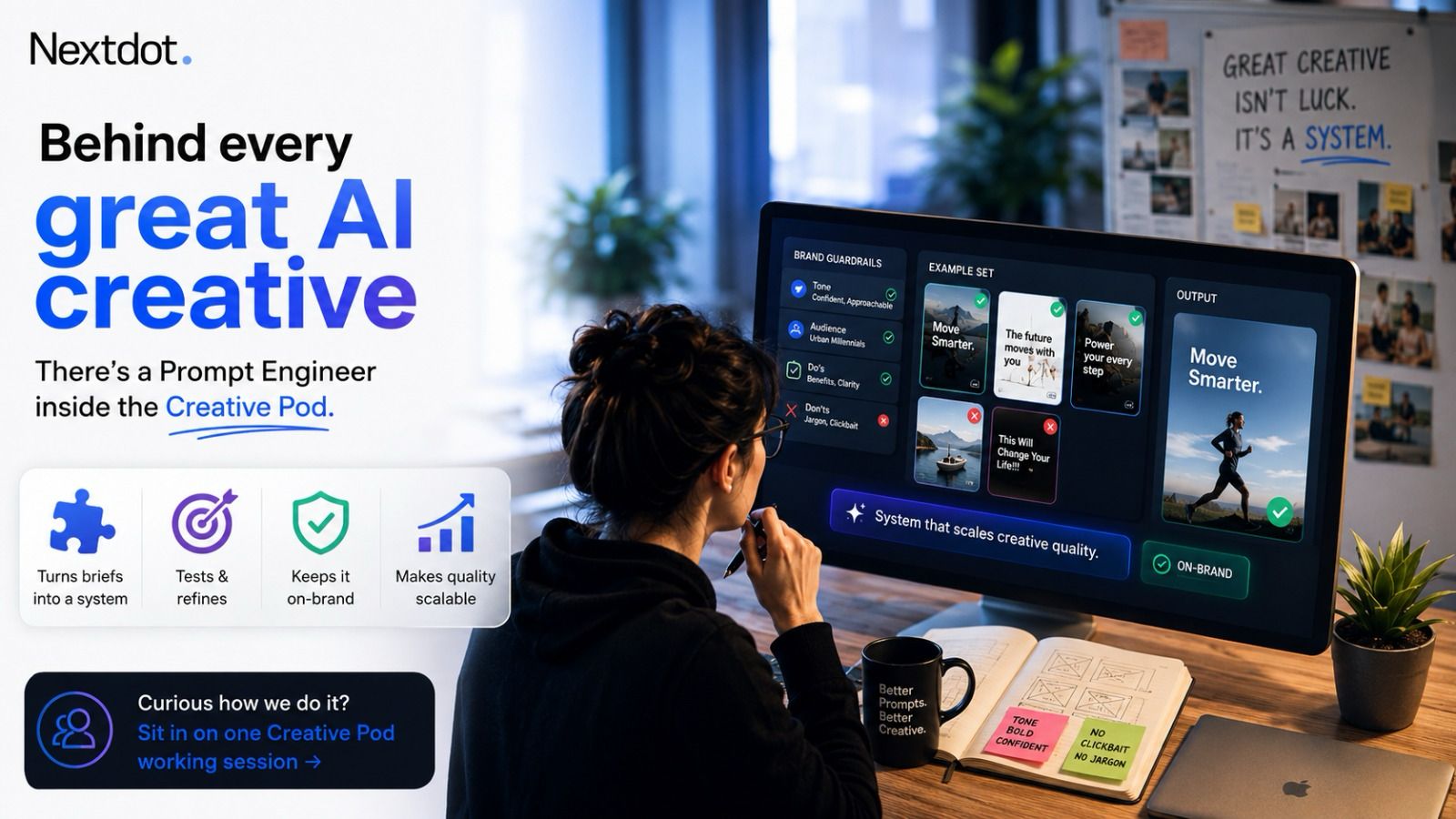
A prompt engineer inside a creative pod spends most of the day building and testing the instructions, examples, and guardrails that make a model reliably produce brand-correct work at volume. The job is closer to a director of photography than a copywriter: they set the conditions so that good output happens on purpose and repeats. In a marketing pod that means turning a creative brief into a repeatable generation system, curating reference examples, running variants against a rubric, catching the model when it drifts off brand, and deciding where a human takes back the pen. The typing of clever one-line prompts is maybe five percent of it.
That gap between the myth and the day matters, because the title itself is dissolving into the work. Glassdoor put median total pay for the role at roughly USD 126,000 as of December 2025, and demand for the skill kept climbing even as "prompt engineer" as a standalone job posting shrank. The craft simply moved inside teams. Inside a creative pod, here is what it looks like hour to hour.
What does a prompt engineer actually do?
Start with the brief. A creative brief written for humans is full of implication: "premium but approachable," "sounds like us," "nothing that would spook compliance." A model cannot read the room. The prompt engineer's first job is translation, turning that brief into something a system can act on without a human re-explaining it every time. That means naming the audience, the format constraints, the banned words, the tone anchors, and the failure modes in language precise enough to be reused across fifty assets.
The output of that translation is rarely a paragraph. It is a structured spec: role definition, task, constraints, worked examples of good and bad, and an output schema. The examples do the heavy lifting. Show a model three on-brand captions and one off-brand one labelled as off-brand, and it will hold a voice far better than any adjective you can write. Curating those examples, from real approved work, is a large part of the day and one of the least glamorous.
Is a prompt engineer just someone who writes clever prompts?
No. The clever single prompt is a party trick. Production creative work needs the same output ten thousand times with variance you can predict. So the real work is systems work.
A typical morning: the pod is producing regional variants of a campaign. The prompt engineer has a base prompt and a set of variables for language, city, and offer. They run a batch, then read the output the way an editor reads galley proofs. Where did the model invent a claim? Where did it slip into a banned phrase? Where did the Hindi variant flatten into translated-English rhythm instead of native phrasing? Each failure gets traced to a cause: a missing constraint, a weak example, a model that needs routing to a stronger tier for that step. This is the loop, generate, evaluate, adjust, that separates a demo from a deliverable.
Evaluation is the discipline most outsiders miss. A prompt engineer builds a rubric before they build the prompt. For a set of ad headlines the rubric might score brand fit, factual safety, length compliance, and distinctiveness. They grade a sample by hand, then, where volume justifies it, set up a model to grade against the same rubric so the pod is not eyeballing every batch. When the numbers move the wrong way after a change, they roll it back. It is measurable, and that is the point.
Where does the prompt engineer sit inside a creative pod?
A creative pod is small and cross-functional. Think a strategist who owns the brief, a designer and a copywriter who own taste, a producer who owns delivery, and a prompt engineer who owns the machine that lets four people output what used to take twelve. The prompt engineer gives the creatives a lever rather than replacing them.
The relationship is constant back-and-forth. The copywriter flags that a batch of captions all open the same way; the prompt engineer diagnoses it as a sampling setting plus a thin example set and fixes both. The designer wants forty background variations that hold a single art-direction rule; the prompt engineer encodes the rule and the negative constraints so the model stops producing the three things the designer hates. Taste stays with the humans who have it. The prompt engineer makes taste scale.
That is why the role reads as engineering rather than writing. On any given day it touches version control for prompts, cost accounting across model calls, caching so repeated context is not paid for twice, and light scripting to chain steps together. When production gets cheap, the constraint shifts to judgement and orchestration, and the prompt engineer sits exactly on that seam.
Why is the standalone job title fading while the work grows?
Because the models got easier to talk to and the skill got absorbed into everyone's job. Frontier models now handle vague, informal instructions reliably enough that hand-crafted phrasing matters less for simple tasks than it did in 2023. Fast Company reported in May 2025 that prompt engineering as a standalone role had largely disappeared, folded into general AI training across functions. The PE Collective's 2026 analysis found the standalone "prompt engineer" title declining by about 30 percent between 2024 and 2026 while the skill itself appeared in a growing share of AI job descriptions.
Read that correctly. The commodity part, coaxing a single good answer, got easy. The hard part got harder and more valuable: building systems that produce brand-safe creative at volume, with evaluation you can defend to a CMO and an audit trail you can show a client. That is a pod capability rather than a lone specialist, which is why we staff it inside the Creative Pod rather than hiring it as a job title on its own.
What does this mean for a CMO buying creative?
Ask a vendor two questions. First, how do you keep the model on brand across a hundred assets, and can you show me the rubric you grade against? A shrug means you are buying demos. Second, who holds taste? If the answer is "the model," walk. The model holds throughput. The prompt engineer holds the system. Your brand still needs a human whose name is on the work.
For regulated categories the stakes rise. If your creative touches health claims, financial promises, or anything a regulator reads, the guardrails a prompt engineer builds are the difference between speed and a liability. Constraints encoded once, tested every batch, beat a reviewer catching problems one asset at a time.
Frequently asked questions
What does a prompt engineer do in one sentence?
They build and maintain the instructions, examples, evaluation rubrics, and guardrails that make an AI model produce reliable, on-brand output at volume, so that good results happen by design rather than by luck.
Do you need to code to be a prompt engineer?
A little coding goes a long way. What matters more are engineering habits: version control, structured testing, cost awareness, and comfort chaining steps. In a creative pod the strongest prompt engineers pair a writer's ear for voice with an engineer's discipline about evaluation.
Is prompt engineering a dying career?
The standalone title is fading while the skill spreads. Glassdoor listed median total pay near USD 126,000 in December 2025, and industry coverage through 2025 and 2026 shows the competency being embedded across AI roles rather than disappearing. The work is consolidating inside teams.
How is a prompt engineer different from a copywriter?
A copywriter writes the piece. A prompt engineer builds the system that lets a small team produce many brand-correct pieces, then measures whether it worked. Taste stays with the creatives; the prompt engineer makes that taste repeatable.
How do you measure whether a prompt engineer is doing good work?
By output quality at volume: brand-fit scores against a defined rubric, rate of banned-phrase and factual errors, cost per approved asset, and how little human rework a batch needs before it ships.