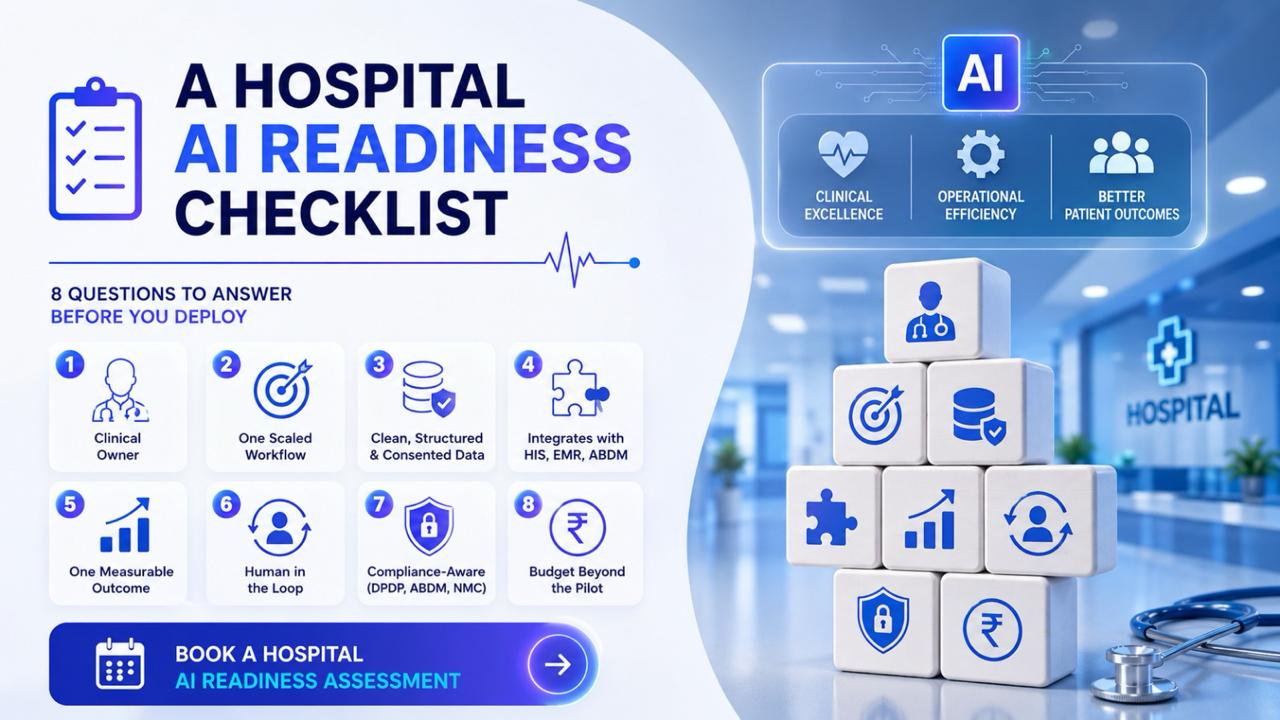
Most hospital AI projects die after the pilot. For every 33 AI pilots a typical enterprise launches, only 4 reach production, according to IDC's 2025 survey cited by Pertama Partners, and RAND's 2024 analysis puts the AI project failure rate at more than 80 percent, roughly twice that of ordinary IT work. Your hospital is ready to deploy AI when you can answer eight questions with evidence rather than optimism: whether you have a named clinical owner, a scoped workflow, clean and consented data, a live integration path, a measurable outcome, a human handoff, a compliance posture under DPDP and NMC, and a budget that survives beyond the pilot. If any answer is a shrug, you are not ready for that use case yet. This checklist walks through all eight.
The good news is that the appetite is real. Over 40 percent of Indian clinicians now use AI at work, a three-fold jump from 12 percent a year earlier, per the 2025 Wolters Kluwer report summarised by IBEF. Appetite is not readiness. Below is how to tell the difference before you sign anything.
Question 1: Do you have a named clinical owner rather than just an IT sponsor?
The most reliable predictor of whether a hospital AI deployment survives is a single accountable clinician who wants the outcome. This is one person rather than a committee, someone with a name, whose day gets better when the system works and worse when it does not.
IT can procure and integrate. Only a clinical owner can decide that an AI scribe's output is safe to sign, that a triage suggestion is acceptable to act on, or that a discharge summary reads correctly. When the owner is a department head who feels the pain of documentation load or OPD throughput, adoption follows. When the project is owned by an innovation function with no clinical stake, it stalls after the demo. Before you proceed, write down the owner's name and the specific problem they are trying to remove from their week.
Question 2: Have you scoped one workflow, or are you buying a platform?
Readiness is workflow-specific. A hospital is never "ready for AI" in the abstract. It is ready, or not, for a particular task in a particular department.
Pick one workflow where the pain is measurable and the boundary is clear: OPD documentation for a single specialty, patient callback and appointment confirmation, insurance pre-authorisation drafting, or front-desk query handling. A narrow scope lets you define what good looks like and lets you fail cheaply if the fit is wrong. Platforms promise everything and get evaluated on nothing. This is why documentation AI shows the strongest results in healthcare, with 53 percent of clinical documentation implementations rated successful in the 2026 Sully.ai data compilation, while broad generative pilots stall: the task was bounded and the output was verifiable.
Question 3: Is your data clean, structured, and consented?
The failure lies in data readiness and workflow integration far more often than in the model, a point RAND and multiple 2025 post-mortems keep returning to. Ask three things of the data behind your target workflow.
Is it accessible, meaning can a system read it without a human copying fields between screens. Is it structured enough, meaning are the fields consistent, or is critical information trapped in scanned PDFs and free-text notes in three languages. Is it consented, meaning do you have a lawful basis to process it for this purpose under the DPDP framework. Fragmented, non-interoperable records are the single most common reason hospital AI never leaves the pilot. If your EMR data for this workflow is messy, the honest move is to fix the data pipeline first and treat that as part of the AI budget.
Question 4: Can it integrate with your HIS, EMR, and ABDM stack?
An AI tool that lives in a separate browser tab will be abandoned within weeks, however good its output. Readiness means the system is workflow-native: it reads and writes where the clinician already works.
Check whether your vendor can integrate with your HIS and EMR through real interfaces, and whether they understand the Ayushman Bharat Digital Mission stack you are increasingly expected to participate in. ABDM has now crossed 100 crore health records linked to ABHA, with more than 450 health-tech solutions integrated into the framework, per a 2025 PIB release. If a deployment cannot fit ABHA-linked records, HFR and HPR registries, and your existing document flow, it sits outside the system of record and slowly dies of friction.
Question 5: What is the one number this deployment will move?
Before build starts, name the outcome. The absence of a defined outcome before build is a leading cause of AI failure across sectors. "Improve efficiency" is not an outcome. "Cut average OPD documentation time per patient from 6 minutes to 3" is.
Choose a metric your clinical owner already cares about and already measures: minutes of documentation per encounter, first-call resolution on patient queries, no-show rate after AI-driven confirmations, pre-authorisation turnaround time, or after-hours physician charting load. Set the baseline now, in writing, before anything is deployed. If you cannot measure the baseline, you will never prove the value, and the finance conversation in month nine will end the project regardless of how the clinicians feel.
Question 6: Where does the human stay in the loop?
In a hospital, full autonomy is the wrong default. Every clinical or clinical-adjacent AI output needs a defined handoff to a human who reviews, edits, and takes accountability.
Decide, per workflow, what the AI is allowed to do alone and what always requires a human sign-off. An AI scribe drafts, the clinician verifies and signs. A voice agent confirms an appointment and answers a routine query, and escalates anything clinical to staff. This boundary is a safety design and a compliance requirement, and it is also what makes clinicians trust the tool enough to keep using it. Nextdot's own voice-first CX agents, live at Narayana Health and Gleneagles and in build at Fortis Mulund, are built around exactly this line: the agent handles the structured, repeatable contact and hands off cleanly when judgment is needed.
Question 7: Are you compliance-aware under DPDP, ABDM, and NMC?
Patient data is sensitive personal data, and the rules around it hardened recently. MeitY notified the DPDP Act and the Digital Personal Data Protection Rules on 13 November 2025, per EY's 2025 analysis, and the healthcare obligations are concrete: free, specific, informed, and revocable consent, transparent notices on data use, protocols for access and erasure, and, for larger hospitals classed as significant data fiduciaries, a data protection officer and continuous auditing.
Layer on the NMC's telemedicine and professional conduct expectations for anything touching clinical advice, and ABDM's data standards for record exchange. India's Telemedicine Practice Guidelines, 2020, are explicit on this point: AI and machine learning may assist and support a registered medical practitioner, and the final counselling or prescription has to be delivered by the practitioner directly. Readiness here means you can answer where patient data flows, who processes it, where it is stored, and whether the AI vendor's contract makes them an accountable processor under the DPDP Rules. A compliance-aware build treats consent, audit trails, and data residency as design inputs from day one rather than a scramble before go-live.
Question 8: Will the budget survive past the pilot?
Pilots are cheap to start and easy to strand. Only 5 percent of generative AI pilots delivered rapid measurable impact, with 95 percent stalling within six months, per the widely cited 2025 MIT NANDA finding referenced across the failure-rate literature. The difference between the 5 and the 95 is often whether anyone budgeted for production.
Budget for the full cost of running the system, meaning integration work, the data cleanup from Question 3, ongoing model and token costs, monitoring, and the staff time to review AI output during the human-in-the-loop phase. Decide up front who owns the line item after the pilot and what success buys: a wider rollout, more specialties, more departments. A deployment with a clinical owner, a measured outcome, and a committed production budget is the profile that survives. One without a post-pilot budget is a demo with a longer runway.
How to use this checklist
Score your target workflow honestly against all eight questions. Eight clear answers means you are ready to deploy that use case now. Five or six means you are close and should fix the gaps, usually data and integration, before you build. Three or fewer means the appetite is ahead of the readiness, and the right move is a scoped assessment rather than a purchase order. Nextdot runs a hospital AI readiness assessment against exactly this frame for teams that want an outside read before committing budget.
Frequently asked questions
How long does a hospital AI readiness assessment take?
For a single scoped workflow, a structured readiness review typically runs one to three weeks: interviews with the clinical owner, a look at the data and integration path, and a compliance check against DPDP and ABDM. The output should be a go, fix-then-go, or not-yet decision with the specific gaps named.
What is the most common reason hospital AI pilots fail?
Data readiness and workflow integration, ahead of the model itself. RAND's 2024 analysis and multiple 2025 healthcare post-mortems converge on this: fragmented, non-interoperable records and tools that live outside the clinician's actual workflow are what strand pilots.
Do we need to be DPDP compliant before we deploy AI?
You need a lawful basis and a consent and data-handling posture in place for the specific data the AI will process. With the DPDP Rules notified in November 2025, treating consent, audit trails, and processor accountability as design inputs is now the baseline rather than a later add-on.
Should our first AI deployment be clinical or administrative?
Most hospitals get a faster, safer first result on a bounded documentation or patient-contact workflow with a clear human sign-off, because the outcome is measurable and the risk is contained. Clinical-decision use cases raise the bar on validation and accountability considerably.
What if our EMR data is messy?
Then fixing the data pipeline is the first phase of the project, and its cost belongs in the AI budget. Deploying on top of inconsistent, unstructured records produces unreliable output and erodes clinician trust before you can prove value.