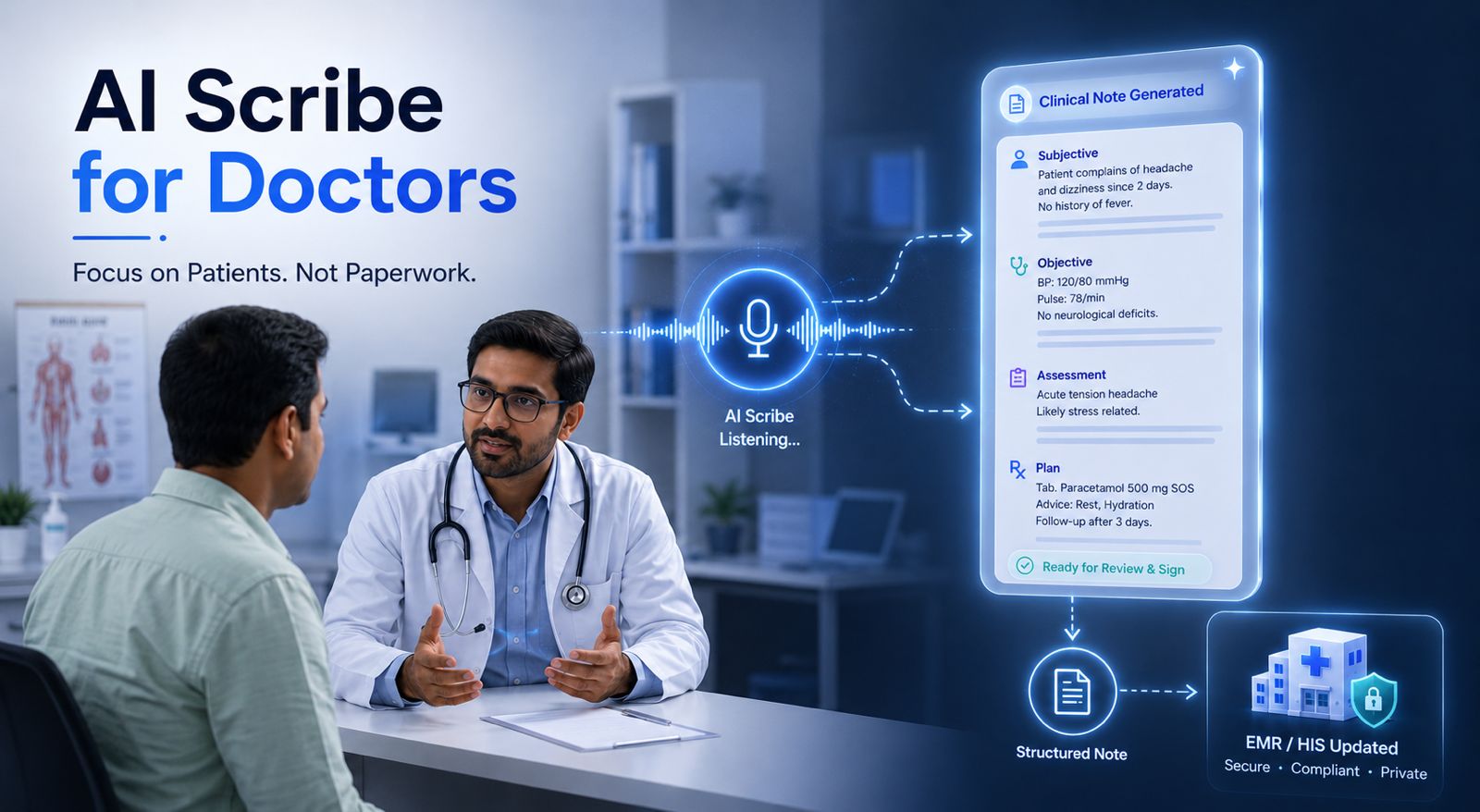
An AI scribe listens to the consultation as it happens and drafts the clinical note on its own, so the doctor can spend the visit looking at the patient instead of typing. It captures the spoken history, examination, and plan, then produces a structured note the doctor reviews and signs. In an Indian OPD, where a single doctor can see more than a hundred patients in a day, that change in where the doctor's attention goes is the whole point. Done well, it gives time back to the doctor, cleaner records to the hospital, and a calmer consult to the patient.
That is the promise. The reality is more specific, and it changes depending on who you are: the doctor in the chair, the tech team that has to make it work, or the owner signing the cheque. Here is what an AI scribe actually does to an OPD day for each of you.
The keyboard tax
Start with the room. In some Indian government super-specialty OPDs, a single department sees more than 200 patients in a working day, and a consultation can run as short as two minutes (Indian OPD time-motion studies). Inside that compressed window, the record still has to be written. The doctor splits attention between the patient and the screen, typing a history while the next patient waits at the door.
The cost of this is measurable. Studies in the United States found physicians spend close to two hours a day documenting outside clinic hours, and the American Medical Association reported in 2024 that 43.2% of physicians had at least one symptom of burnout, with administrative and documentation work among the leading causes. The Indian OPD takes that same documentation burden and forces it into a far tighter day. The keyboard becomes a third party in the consultation, and the patient gets the doctor's profile instead of their eyes.
What the doctor feels
An ambient scribe sits quietly in that consultation. It listens to the conversation, in the room, and drafts the note in the background. The doctor talks to the patient, examines, explains, and the structured note is waiting for review at the end. The eye contact comes back. The after-hours charting shrinks.
It helps to be honest about the size of the gain, because the senior reader has heard the hype. A study of 1,800 clinicians across five academic medical centres found that scribe users saved around 16 minutes of documentation time for every eight hours of patient care (STAT, 2026). A randomised trial at UCLA found smaller per-note savings that reached statistical significance for one tool (UCLA Health, 2025). The gains are real and measurable, modest per consult rather than dramatic, and they compound across a heavy OPD list. The burnout effect is the part that matters most: one study saw burnout among ambulatory clinicians fall from 51.9% to 38.8% after a month with an ambient scribe. For a doctor carrying an Indian patient load, getting attention back on the patient is worth more than the minutes alone.
What the tech team will ask
If you run the hospital's technology, your first question is accuracy, and you are right to lead with it. A scribe that mishears a drug name or a dosage creates clinical risk and erases its own time savings in a single line. Test it on real OPD audio, with background noise, accents, and interruptions, rather than on a clean demo recording. The large multi-centre study found that time savings depended heavily on consistent, well-fitted use, and faded where the tool did not match the real workflow.
Your second question is integration. The finished note has to land in the right field of the hospital information system or EMR the clinicians already use, rather than in a separate document someone copies across later. A scribe that produces a beautiful note in its own app, disconnected from the record, has moved the work rather than removed it.
The Indian-language reality
This is where many tools quietly fail, and it deserves its own attention. An Indian OPD conversation is rarely clean English. A history is taken in Hindi, switches to English for the drug name, drops into Marathi or Bengali or Tamil for a symptom, and carries English medical vocabulary inside a Hindi sentence. A model trained on American English will mis-transcribe exactly the words that carry clinical weight.
The real accuracy bar for India is Hindi plus code-switching plus regional languages plus English medical terms, often inside a single spoken line. A scribe that handles this is genuinely useful in an Indian OPD. A scribe that does not will frustrate the doctor by the third patient. This is the clearest reason to prefer a system built in India, for Indian clinical speech, over one ported in from another market.
Patient data is the part you cannot get wrong
A scribe records the patient's voice and their clinical details. Under India's Digital Personal Data Protection Act, 2023, that is sensitive personal data, and handling it carelessly is a liability dressed as a productivity tool. This is the question that should sit at the top of the owner's list, alongside the doctor's time.
Ask where the audio is processed and stored, whether it stays inside India, who can access it, how long it is kept, and whether it is deleted once the note is written. Ask how patient consent is taken and recorded, because the patient should know the consultation is being captured and should agree to it. A serious scribe is consent-first and built around these answers from the start. A tool that sends patient audio to an unnamed overseas server, with no clear deletion policy, is a problem the hospital will own long after the demo impressed everyone.
What it means for the owner
For the clinic or hospital owner, the return shows up in quiet places rather than a single headline number: the doctor finishing the OPD without an hour of charting afterward, fewer errors in the record, faster and cleaner billing, and a lower chance of losing a good clinician to exhaustion. Modest per-consult savings, multiplied across a department and a year, compound into real capacity and real retention.
The discipline is in how you buy. Choose on accuracy tested with your own audio, on genuine Indian-language handling, and on patient-data practices that satisfy DPDP, rather than on the polish of the demo. A scribe judged on those three things earns its place in the OPD. One judged on the demo alone usually does not survive contact with a real clinic.
Nextdot Digital Solutions Pvt. Ltd. builds voice-first clinical systems designed for Indian OPDs, tuned for Indian languages and built around DPDP-aligned patient-data handling. If you are weighing a scribe for your practice or hospital, those are the questions worth starting from.
Frequently asked questions
How can AI cut documentation and admin work for doctors in India?
An AI scribe listens to the consultation and drafts the clinical note automatically, so the doctor reviews and signs rather than types from scratch. Studies show documentation time savings of roughly 16 minutes per eight hours of patient care, with the larger benefit being attention back on the patient and lower burnout.
Does an AI scribe work for Indian languages and Hinglish?
Only if it is built for them. Indian OPD speech mixes Hindi, regional languages, and English medical terms in the same sentence, and a model trained on American English will mis-transcribe the clinical words that matter most. Test any tool on real, code-switched OPD audio before trusting it.
Is an AI scribe safe for patient data under DPDP?
It can be, if it is designed for it. Patient audio and clinical details are sensitive personal data under India's Digital Personal Data Protection Act, 2023. Confirm where the data is processed and stored, that consent is taken and recorded, and that audio is deleted after the note is produced.
How much time does an AI scribe actually save?
Less than the marketing suggests and more than nothing. A study of 1,800 clinicians across five centres found about 16 minutes saved per eight hours of care, and savings depend heavily on accuracy and how well the tool fits the existing workflow.
Who should evaluate a scribe tool: doctors, IT, or management?
All three, on different criteria. Doctors judge whether it captures the consult correctly, IT judges accuracy and integration, and owners judge data handling, compliance, and return. A tool that satisfies only one of the three rarely lasts.