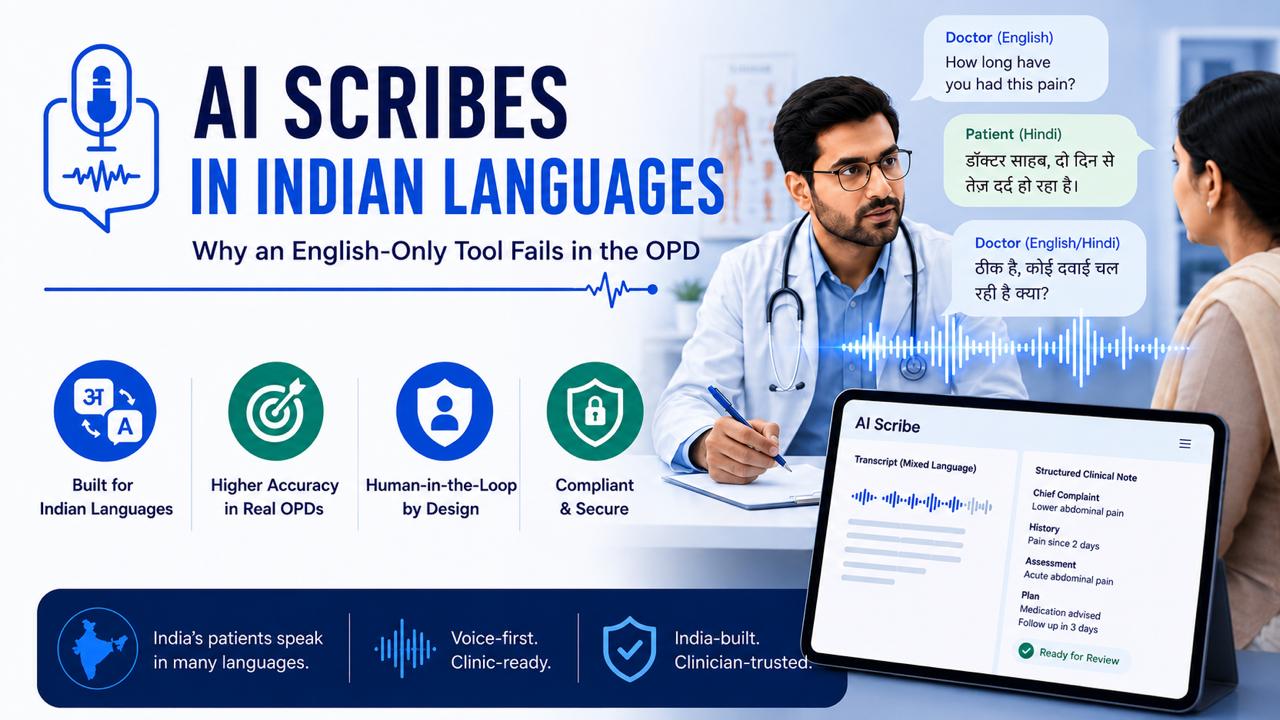
Yes, AI medical scribes can work in Hindi and other Indian languages, but almost none of the tools sold in India today were built for the way an actual OPD sounds. A real consultation is a doctor asking questions in English, a patient answering in Hindi or Bhojpuri, and the doctor switching mid-sentence to explain a dosage. English-only speech recognition treats that as noise. The scribe that works in your OPD is one trained on code-switched, clinical, accented speech, with a review step before anything reaches the record. This piece explains where English-only tools break, what to test before you buy, and what a compliance-aware Indian scribe actually needs.
Do AI medical scribes work in Indian languages?
They work when the underlying speech recognition was built for Indian speech, and they fail predictably when it was not. The gap is measurable. The India Census 2011 recorded 121 languages and 270 mother tongues, with Hindi as a native language for roughly 43.63 percent of the population, about 528 million people (Census of India 2011, via Wikipedia). English, by contrast, was reported as a spoken language for around 10.2 percent, close to 128.5 million people, and most of those speak it as a second or third language (Census of India 2011, via The History of English). A scribe tuned for the 10 percent will produce a clean note for the consultant and an empty or wrong note for the patient's own words.
That is the first thing clinical leaders should internalise. The doctor's speech is the easy part. The patient's speech, in the vernacular, under stress, in a crowded room, is where the value and the risk both sit.
Why do English-only scribes break in the OPD?
Three failure modes show up again and again in real deployments.
The first is code-switching. Indian clinical conversation moves between languages inside a single utterance. Research on Hinglish speech estimates more than 250 million people in India communicate this way, blending English and Hindi (HiACC corpus, ScienceDirect, 2025). Speech models trained on monolingual data degrade sharply here. Studies report a relative rise in word error rate of roughly 30 to 50 percent when a model built for single-language input meets code-switched speech (HiACC corpus, ScienceDirect, 2025). A note that is wrong three times more often is a note a doctor stops trusting.
The second is the accuracy floor for Indian languages themselves. Even leading systems sit well above the error rates clinicians assume from consumer demos. Benchmarks put Hindi word error rate for strong models around 16 percent in field conditions (Benchmarking ASR for Indian Languages, arXiv 2026). A recent clinical audit across Kannada, Hindi and Indian English found the same pattern inside real doctor-patient interviews: error rates were lowest for English, highest for Kannada, with Hindi in between, a bias the authors trace directly to training data (ASR Under the Stethoscope, arXiv 2025). The worse the model handles a language, the worse it handles the patients who speak only that language.
The third is clinical vocabulary. Drug names, doses, anatomy and abbreviations are their own dialect. A general-purpose model transcribing a Hindi consultation will often get the conversation broadly right and the one clinically load-bearing word, a drug name, a frequency, a dosage, wrong. In a scribe, that single word is the whole point.
What does an India-built scribe need that a global tool does not?
Start with the data the model learned from. A scribe that performs in your OPD was trained on Indian clinical audio: real accents from across states, real code-switching, real ambient noise from a shared consultation room. Global tools optimise for clean American or British English recorded on good microphones. That distribution does not match a Tuesday morning OPD anywhere in India.
Second, the system has to be voice-first and workflow-native rather than a transcription box bolted onto an unrelated interface. The doctor should speak naturally and get a structured note back in the format the department already uses, with the vernacular patient history preserved and the clinical plan captured in the doctor's own terms.
Third, and this is the part vendors skip, there has to be a human review step before anything becomes part of the record. An accountable scribe drafts, and a clinician verifies. Given the error rates above, treating a raw transcript as a finished clinical document is unsafe. The design goal is to save the doctor typing time while keeping a person in the loop on every note that enters the patient's file.
How does this sit with DPDP, ABDM and NMC rules?
Voice is personal data, and clinical voice is sensitive personal data. Under the Digital Personal Data Protection Act 2023, patient audio and any transcript derived from it need a lawful basis, purpose limitation, and clear handling of storage and deletion. For a scribe that means being explicit about where audio is processed, whether it leaves the country, how long recordings are kept, and how consent is captured before recording begins.
There is a second reason to prefer India-built processing. If a scribe ships raw patient audio to a general overseas model to transcribe, the clinic has widened its data exposure for a marginal quality gain that, on Indian speech, may not even exist. Keeping speech processing on infrastructure you can point to, with data residency you can name, is easier to defend to a hospital board and to a regulator.
On the clinical side, the National Medical Council's framing of the medical record as the doctor's responsibility does not change because a machine drafted the first version. The consultant who signs the note owns the note. That is exactly why the review step is a compliance requirement rather than a nicety. Where the scribe feeds into ABDM-linked records, the accuracy of the structured output stops being a convenience feature and becomes part of a shared health record other clinicians will act on.
What should a clinical leader test before buying?
Run the pilot on your hardest cases rather than the demo script. A short, practical checklist:
- Record ten real consultations in the languages your patients actually speak, including at least three heavy code-switching cases, and compare the scribe's note against a clinician's own note.
- Check the clinically load-bearing tokens specifically: drug names, doses, frequencies, allergies. Broad fluency is worthless if these are wrong.
- Ask the vendor what Indian clinical audio the model was trained on, and treat a vague answer as a red flag.
- Confirm where audio and transcripts are processed and stored, and get the DPDP consent and retention position in writing.
- Time the full loop including review. A scribe that produces a beautiful draft nobody trusts saves nothing.
The honest answer to whether AI scribes work in Indian languages is that the technology is ready and most of the products are not, because they were built for a patient who speaks fluent English into a quiet microphone. That patient is a small minority of any Indian OPD. Buy for the OPD you have.
Frequently asked questions
Do AI scribes support Hindi and regional languages?
Some do, but support varies widely. The models that perform were trained on Indian clinical speech including code-switching. Ask for language-specific accuracy on your patient population rather than accepting a general claim of multilingual support.
How accurate are AI scribes in Indian languages?
Field benchmarks put Hindi word error rate for strong models around 16 percent, and higher for less-resourced languages, with accuracy dropping a further 30 to 50 percent on code-switched speech (arXiv 2026; ScienceDirect 2025). This is why a clinician review step before the note is finalised is essential.
Can one scribe handle a doctor and patient switching between languages?
Only if it was designed for code-switching. A conversation that moves between English and Hindi inside one sentence is common in Indian OPDs and is precisely where monolingual tools fail most.
Is voice data from consultations safe under DPDP 2023?
Clinical voice is sensitive personal data. A compliant scribe captures consent before recording, limits use to the stated clinical purpose, and is explicit about where data is processed, stored, and deleted. Prefer systems that can name their data residency.
Does an AI scribe replace the doctor's medical record duty?
No. The clinician who signs the note remains responsible for it. A well-designed scribe drafts and the doctor verifies, which keeps the workflow both faster and accountable.