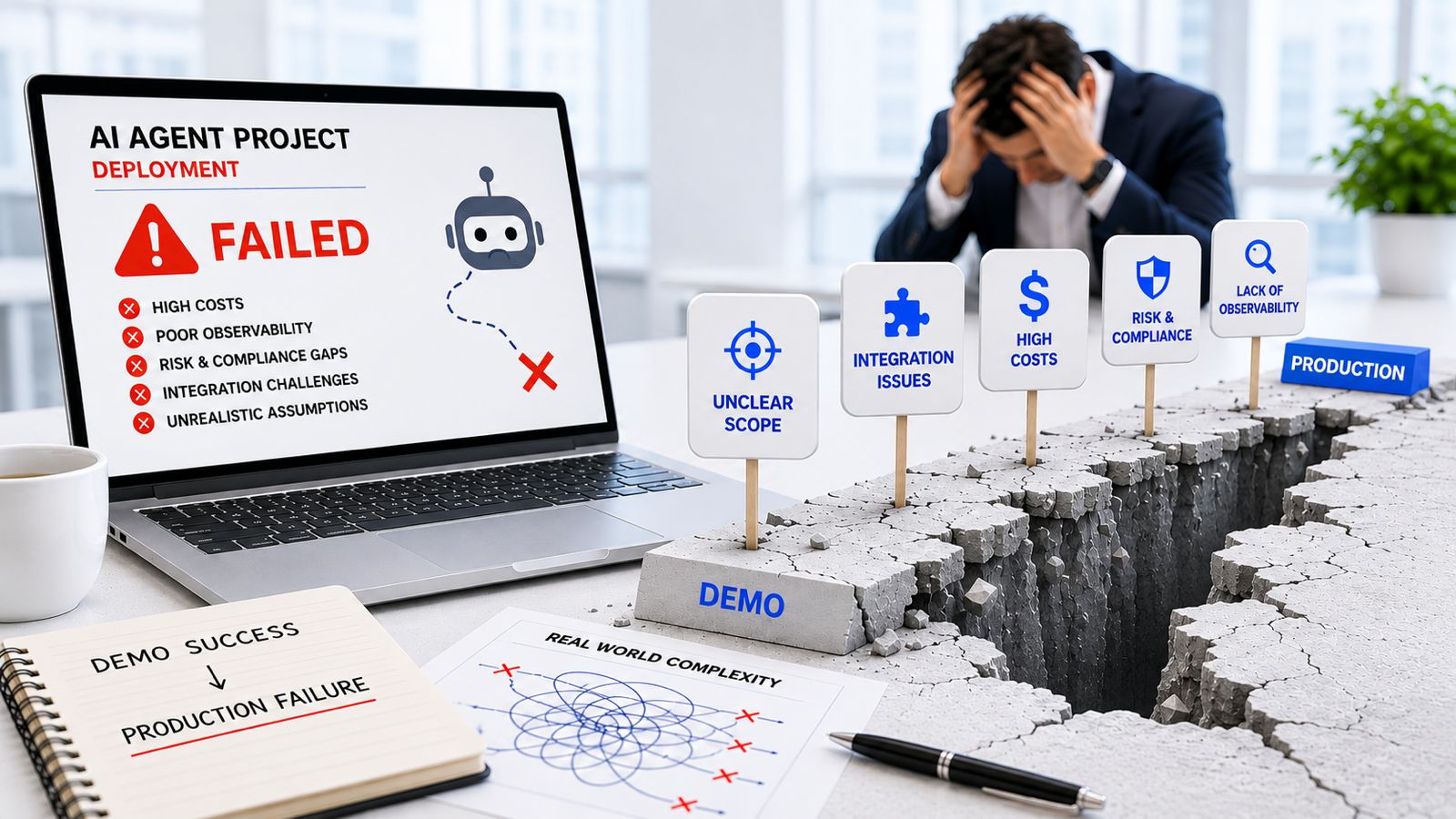
Enterprise AI agent projects fail in production for reasons that have almost nothing to do with model quality. They fail because a demo that works on ten happy-path inputs meets a live workflow with thousands of edge cases, no error budget, and a cost curve nobody modelled. Gartner predicts over 40% of agentic AI projects will be canceled by the end of 2027, and the causes it names are escalating cost, unclear business value, and inadequate risk controls. Every one of those is an engineering and scoping problem. The model is usually the part that already works. What follows is the failure pattern we see repeatedly, and the parts of the system that decide whether an agent survives contact with real traffic.
Is the model actually the problem?
Start with the number that reframes the whole conversation. Gartner's June 2025 prediction, drawn from a poll of more than 3,400 organizations investing in the technology, puts cancellation above 40% by 2027 and attributes it to cost, value, and risk rather than accuracy (Gartner, 25 June 2025). MIT's Project NANDA study "The GenAI Divide," published in 2025 and covering more than 300 enterprise deployments, found that 95% of generative AI pilots produced no measurable return, and the researchers were explicit that adoption and integration failures drove the gap rather than weak models (MIT Project NANDA, 2025).
That distinction matters because most engineering teams over-invest in model selection and under-invest in everything around it. A frontier model at 90 to 95 percent single-step accuracy is more than good enough for a well-scoped task. The failure sits in the assumption that single-step accuracy carries over to a multi-step workflow. It does not, and the arithmetic is unforgiving.
Why does a 95% accurate agent still fail?
An agent that completes a task is really running a chain of steps, and errors compound across the chain. If each step succeeds 95 percent of the time and a task needs ten steps in sequence, overall success is 0.95 to the tenth power, roughly 60 percent. Drop per-step accuracy to 90 percent and ten steps land at about 35 percent. Those are not model failures. Each step performed to spec. The workflow still failed most of the time because probabilities multiply.
There is a second, nastier effect on top of the multiplication. The 2025 paper "The Illusion of Diminishing Returns: Measuring Long Horizon Execution in LLMs" describes self-conditioning: once a model's context window contains its own earlier mistakes, it becomes measurably more likely to produce further mistakes downstream (arXiv:2509.09677, September 2025). Step five is not reasoning over clean inputs. It is reasoning over whatever steps three and four corrupted. This is why agents that look reliable in a single-turn demo degrade sharply as the task lengthens.
The engineering response is structural. Shorten the chains. Verify between steps rather than at the end. Insert a human handoff at the highest-risk action. Design so that one bad step has a small blast radius instead of poisoning the rest of the run. Teams that skip this ship a demo and call it a product.
What actually breaks when you go from demo to production?
Four things break, in roughly this order.
The first is input distribution. A demo runs on inputs the builder chose. Production runs on inputs users choose, including malformed data, ambiguous requests, and the long tail of phrasings no one anticipated. An agent tuned on clean examples meets dirty reality and its accuracy per step drops from the demo's 95 percent to something lower, which then compounds across the chain as above.
The second is cost. Agentic workflows call models repeatedly, carry long contexts, and retry on failure. A task that costs a few cents in a demo can cost far more at scale once retries, tool calls, and verification loops are counted. Gartner names escalating cost as a leading cancellation cause for a reason. Teams that never modelled token cost per completed task, as opposed to token cost per call, discover the unit economics only after launch.
The third is observability. When a multi-step agent produces a wrong answer, you need to know which step failed and why. Most projects instrument the model call and nothing else. They cannot see the tool that returned stale data, the retrieval step that pulled the wrong document, or the prompt assembly that dropped a field. Without step-level tracing, every incident becomes a guessing exercise, and mean time to resolution stays high enough to erode trust.
The fourth is governance. An agent that can take actions can take wrong actions. In regulated industries this is not a theoretical concern. An agent touching patient data operates under the DPDP Act 2023 and, for clinical contexts, under NMC and ABDM expectations about consent and record-keeping. If the system cannot show what it did, on whose data, and under what authorisation, it cannot go live regardless of how well the model performs. Governance built after launch is governance that blocks launch.
Why do pilots succeed and production deployments fail?
Because a pilot optimises for the wrong thing. A pilot proves the model can do the task once. Production requires the system to do the task reliably, cheaply, observably, and safely, thousands of times, under inputs no one screened. Those are different engineering problems, and the second one is where the work actually is.
There is a buy-versus-build signal in the data worth sitting with. MIT's NANDA study found that buying from specialised vendors and building partnerships succeeded roughly 67 percent of the time, while internal builds succeeded about a third as often (MIT Project NANDA, 2025). The reading is that the gap reflects the surrounding system rather than any shortage of internal talent. The evaluation setup, the cost controls, the tracing, the guardrails: that layer is expensive to build from scratch and easy to underestimate when the model itself feels done.
Vendor selection carries its own trap. Gartner estimated that of the thousands of firms marketing agentic products, only about 130 were building genuinely agentic systems, with the rest engaged in "agent washing," rebranding chatbots and RPA as agents (Gartner, 25 June 2025). A demo tells you a vendor can produce a demo. It tells you nothing about production behaviour.
What separates the agents that survive?
The ones that survive treat the agent as a system with four load-bearing parts, and they build each part before scaling traffic.
Scoping comes first. Pick a task narrow enough that the chain is short and the failure modes are countable. A three-step agent with verified inputs beats a ten-step autonomous agent that fails 60 percent of the time. Ambition at the scoping stage is the most common self-inflicted wound.
Evaluation comes next. Build a test set from real production-shaped inputs, including the ugly ones, and measure per-step and overall accuracy before launch. If you cannot measure it, you cannot defend it when it drifts.
Cost modelling follows. Compute cost per completed task under realistic retry and context assumptions, then apply model routing so cheap models handle easy steps and expensive models handle only the steps that need them. Caching repeated context cuts spend further. These are the levers that keep unit economics from killing an otherwise working agent.
Control closes the loop. Step-level tracing, guardrails on actions, a human handoff at the riskiest decision, and an audit trail that satisfies a compliance reviewer. In regulated deployments this part is the difference between a system that ships and one that stalls in review.
This is the shape of the work at Nextdot. Our voice-first CX agents run in production at Narayana Health and Gleneagles and are in build at Fortis Mulund, and the reason they run is that the evaluation, cost, observability, and governance layers were built alongside the model rather than after it. The model was the easy part. The system around it is the product.
The uncomfortable summary
Enterprise agent projects fail in production because teams solve the visible problem, model output on curated inputs, and defer the invisible ones: compounding error across steps, cost at scale, step-level observability, and governance that survives an audit. The published data points the same way. Cancellations are driven by cost, value, and risk rather than accuracy. Pilots that never modelled production-shaped inputs collapse when they meet them. The fix is unglamorous and specific: narrower scope, real evaluation, cost per completed task, tracing, guardrails, and a human at the risky step. Build those, and the model does its job. Skip them, and the best model in the world still ends up in the 40 percent that gets canceled.
Frequently asked questions
Why do most enterprise AI agent projects fail in production?
They fail on system engineering rather than model quality. Gartner attributes projected cancellations to escalating cost, unclear business value, and inadequate risk controls (Gartner, 25 June 2025). Errors compound across multi-step workflows, costs scale with retries and context, observability is thin, and governance is added too late.
Is the underlying model usually the reason an agent fails?
Rarely. A frontier model at 90 to 95 percent single-step accuracy is adequate for a well-scoped task. The failure comes from stacking many steps, where 95 percent per step over ten steps compounds to roughly 60 percent overall success.
What is the single most common mistake teams make?
Scoping too wide. A long autonomous chain multiplies error and cost. A short, verified workflow with a human handoff at the risky step is far more likely to reach production and stay there.
Does buying from a vendor beat building in-house?
The MIT NANDA data suggests buying and partnering succeeded about 67 percent of the time versus roughly a third as often for internal builds (MIT Project NANDA, 2025). The gap reflects the cost of the surrounding system rather than internal skill. Vet vendors for production behaviour, since Gartner flagged widespread "agent washing."
How does regulation affect agent deployment in India?
An agent that acts on personal or clinical data must satisfy the DPDP Act 2023 and, in clinical settings, NMC and ABDM expectations on consent and records. The system has to show what it did, on whose data, and under what authorisation, or it does not clear review.