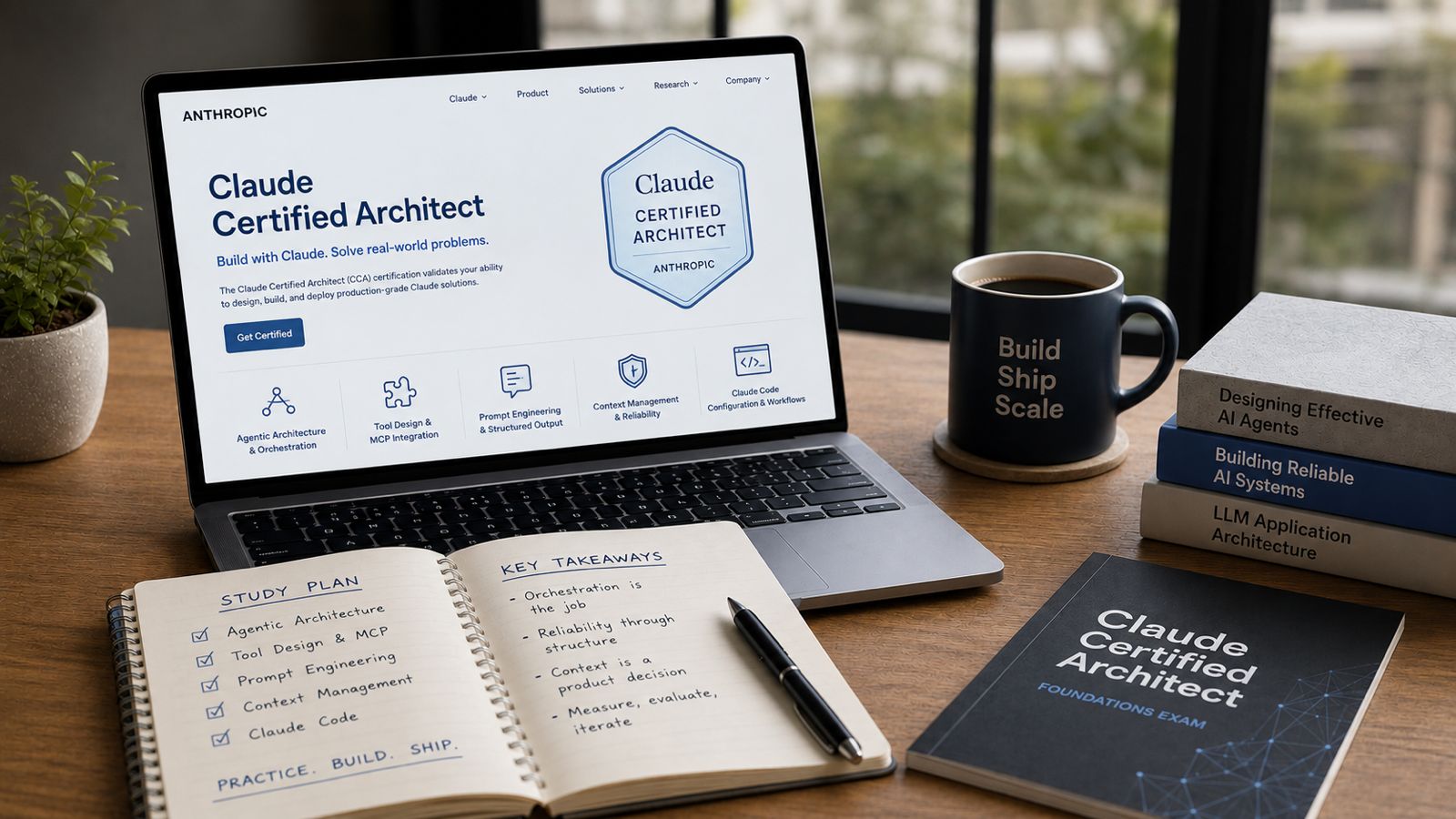
The Claude Certified Architect certification is Anthropic's first official technical credential. Anthropic launched the Foundations exam (CCA-F) on 12 March 2026 as part of the Claude Partner Network (Anthropic via Pearson VUE, 2026). It is a 120-minute, 60-question proctored exam, closed-book, with no AI assistance permitted, and it costs $99 per attempt (AI Data Insider, 2026). You need 720 out of 1,000 points to pass. Is it worth it? For an engineer who already ships production agents, yes, as a forcing function and a shared vocabulary. As a substitute for real deployment experience, no.
One of our engineers is sitting the exam this quarter, so we read the blueprint the way we read any spec: closely, and with an eye for what it reveals about how the vendor thinks agents should be built.
What is the Claude Certified Architect certification?
The Foundations exam validates whether you can design and ship production-grade Claude applications at enterprise scale. It is delivered online with a webcam proctor, in a single sitting, with no external resources (findskill.ai, 2026). The five domains, and their weightings, are worth reading as a statement of priorities:
- Agentic architecture and orchestration, 27 percent
- Claude Code configuration and workflows, 20 percent
- Prompt engineering and structured output, 20 percent
- Tool design and MCP integration, 18 percent
- Context management and reliability, 15 percent
Read that distribution again. Orchestration is the single largest slice, and context management plus reliability closes the list. Prompt engineering, the skill most people still equate with "using Claude well", sits in the middle. That ordering matches what actually breaks in the field, and it is the first thing the exam taught us: Anthropic is now certifying systems thinking, and treating clever prompting as table stakes.
Is it worth it?
Depends entirely on what you want from it.
For a working agent engineer, the credential is worth the two to four weeks of preparation, mostly because of what the preparation makes you confront. Most developers with hands-on Claude experience report needing 15 to 20 hours of study, while newer users should budget 30 to 40 hours (zenvanriel.com, 2026). The material is free. Anthropic Academy ships 13 courses covering the exam domains, including tracks for MCP development, the Claude API, and Claude Code (aiproductivity.ai, 2026). So the real cost is your time plus $99, and if you work at a partner organisation you may pay nothing: the first 5,000 attempts from Claude Partner Network employees were offered free (findskill.ai, 2026).
For a buyer evaluating an AI vendor, the certification is a weak signal on its own and a useful one in context. A badge tells you an individual studied a blueprint and passed a multiple-choice test under proctoring. It does not tell you they have ever kept an agent stable under real traffic in a regulated industry. Ask for the deployment story, then use the certification to confirm the team shares Anthropic's current mental model rather than an outdated one.
One caveat on the credential itself. Anthropic's issuing platform lists a validity window for the standard certificate, and several third-party sites quote a different, longer window. Where those disagree, trust the platform that issues the certificate over the SEO clones that quote each other (findskill.ai, 2026). The prep guides we checked report a six-month validity for the standard certificate, with an early-adopter badge for the beta cohort that does not expire, so confirm the current terms at registration (findskill.ai, 2026).
What the blueprint confirmed about production agents
The exam blueprint is, in effect, Anthropic's opinion on what a production agent requires. Three points lined up with hard lessons from our own deployments.
First, orchestration is the job. When an agent fails in production, the failure is rarely a bad single response. It is a control-flow problem: the wrong tool called at the wrong step, a handoff that never happened, a loop with no exit. The 27 percent weighting on agentic architecture says the same thing we tell clients: the model is a component, and the system around it is where the engineering lives.
Second, structured output and tool design are reliability features rather than conveniences. Grouping tool design with MCP integration, and pairing prompt engineering with structured output, reflects how brittle free-text handoffs are between steps. An agent that returns a typed, validated object can be checked. An agent that returns a paragraph has to be parsed and hoped over. In compliance-aware work, that difference decides whether a workflow is auditable.
Third, context management is a first-class discipline. The exam gives it its own domain alongside reliability. Anyone who has watched an agent degrade as a conversation grows, or watched token costs climb because nothing was pruned or cached, knows why. Managing what the model sees, and when, is now a core skill rather than an optimisation you reach for at the end.
None of this is exotic. It is what we argue in the rest of this series. The value of seeing it in a vendor's certification blueprint is that it is now the industry baseline, and you can hold teams to it.
Where a certification stops being useful
A closed-book exam measures individual knowledge on exam day. Production agents are a team sport played over months. The exam cannot test how you run an incident when an agent starts hallucinating tool arguments at 2 a.m., how you version prompts across a fleet, or how you handle a client's DPDP obligations when the agent touches patient data. Those are the questions that separate a demo from a deployment, and they live outside any multiple-choice format.
There is also an ecosystem of noise to walk past. Search for this certification and you will find dozens of prep sites, several of them clearly generating content at scale, some contradicting each other on basic facts. That noise is itself a lesson for buyers: verification is now a skill. Treat the issuing source as authoritative and discount the rest.
So we are having our engineer take the exam, and we are clear about why. It sharpens a shared vocabulary across the team, it confirms our architecture matches where Anthropic is heading, and it gives clients one more verifiable data point. It changes nothing about how we actually earn trust, which is by keeping voice-first agents live in real hospitals and standing behind them when they misbehave.
Frequently asked questions
What does the Claude Certified Architect exam cost?
The Foundations exam is $99 per attempt in 2026. The first 5,000 attempts from Claude Partner Network employees were offered free (findskill.ai, 2026).
How long is the exam and how many questions?
It runs 120 minutes and has 60 multiple-choice and multi-select questions, delivered online with a webcam proctor, closed-book, in a single sitting (findskill.ai, 2026).
What score do I need to pass?
720 out of 1,000 points (claudearchitectcertification.com, 2026).
How long should I study?
Anthropic and prep guides suggest two to four weeks. Developers with hands-on Claude experience report 15 to 20 hours; newer users should budget 30 to 40 hours (zenvanriel.com, 2026).
Does the certification expire?
Prep guides report a six-month validity for the standard certificate, with a non-expiring early-adopter badge for the beta cohort, while some third-party sites quote longer windows. Trust the issuing platform over secondary sites, and confirm the current terms at registration (findskill.ai, 2026).