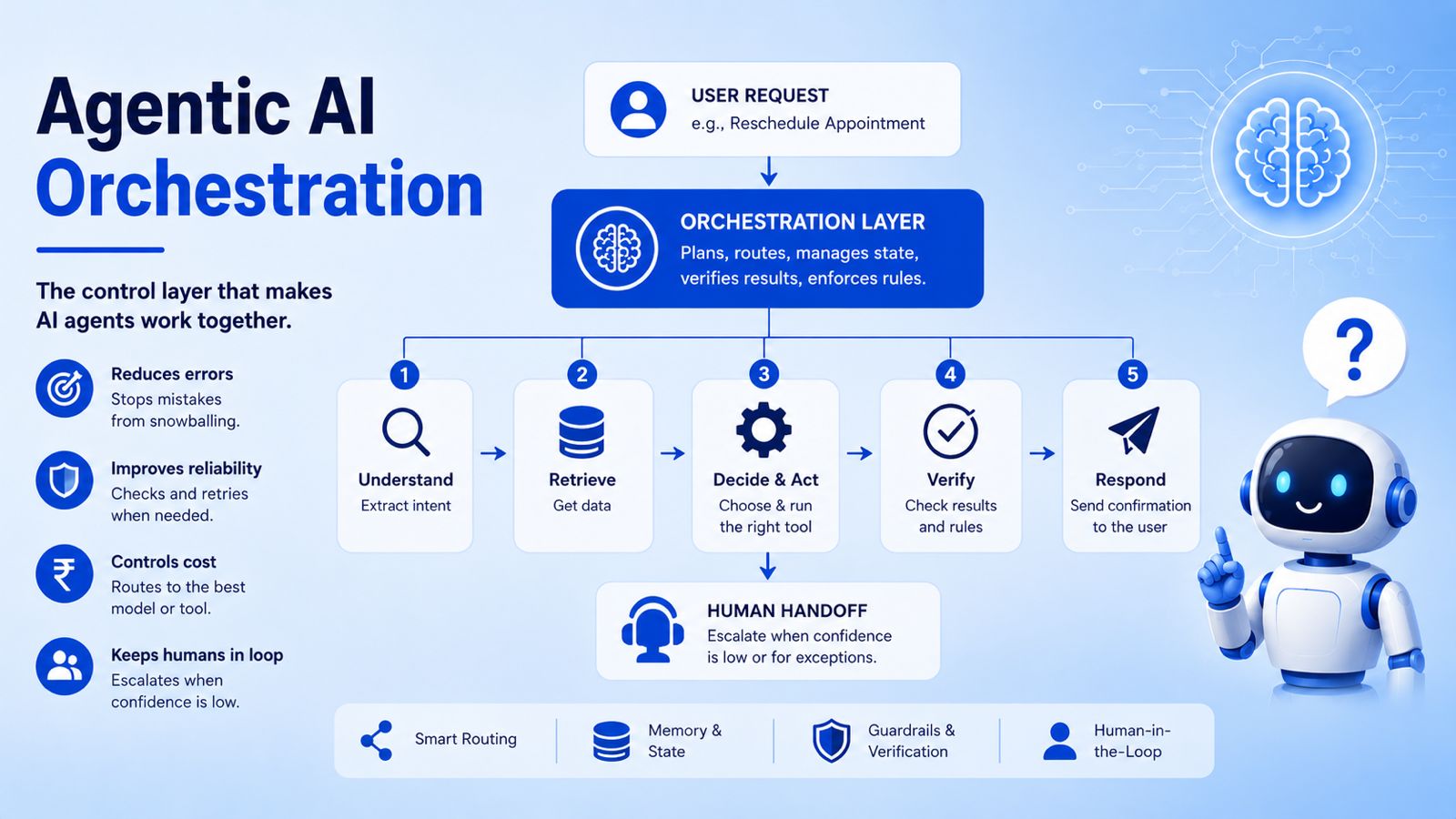
Agentic AI orchestration is the control layer that decides which AI agent or tool runs, in what order, with what data, and when a human takes over. A single chatbot answers a question. An orchestrated system breaks a real task into steps, routes each step to the right model, tool, or database, checks the result, and either continues or stops and hands the work to a person. Orchestration is the difference between a demo that impresses a boardroom and a system that survives contact with production traffic on a Monday morning. This guide explains the concept in plain terms, why it matters commercially, and what to ask before you buy.
What does "orchestration" actually mean here?
Borrow the word from music. A conductor's job is to decide who plays, how loudly, and when they stop, rather than to play an instrument. Agentic orchestration plays the same role for a group of AI agents.
An agent, in this context, is a program that uses a language model to reason about a goal and then take actions: search a record, call an API, draft a reply, book a slot. On its own, one agent is a talented but unsupervised worker. It will confidently do the wrong thing at speed. Orchestration is the supervising layer that turns a group of these workers into a workflow you can trust with a customer, a patient, or a payment.
Concretely, an orchestration layer handles four jobs. It decomposes a request into a plan of discrete steps. It routes each step to the appropriate agent, model, or tool based on cost and capability. It manages state and memory so step four knows what step two decided. And it enforces control, retries, guardrails, verification, and the handoff to a human when confidence drops. Take any of those four away and you have a script that breaks the first time reality deviates from the happy path.
Why can't one big model just do everything?
This is the most common misconception among decision-makers, and it costs real money. The instinct is that a more capable model removes the need for orchestration. The maths says the opposite.
Multi-step work fails through compounding error. If each step in a workflow is 95 percent accurate and the steps depend on one another, a ten-step task succeeds only about 60 percent of the time, because 0.95 to the power of ten is roughly 0.6. Push to 99 percent per-step accuracy across a hundred steps and overall success across the whole chain still falls to around 37 percent, per the compounding-error analysis published by Lens (June 2026). Real workflows are worse than the raw multiplication suggests, because errors are correlated: a wrong answer at step two becomes the ground truth that step three trusts.
A single large model faces the same trap. Every reasoning hop inside it is still a step that can drift. Orchestration attacks the problem structurally. It keeps each step small and verifiable, checks outputs before passing them forward, and stops error from propagating silently down the chain. The fix for compounding error is a system that catches mistakes between steps, rather than a smarter model that hides them.
What does an orchestration layer look like in practice?
Picture a patient calling a hospital to reschedule a follow-up. A voice-first agent answers, understands the intent, and needs to act. Behind that one conversation, the orchestration layer is busy.
It identifies the caller against the hospital record. It checks the treating doctor's live availability through a scheduling API. It applies rules: this consultant does not take new slots within 24 hours, this patient has an unpaid balance that needs flagging. It drafts the confirmation, verifies the slot was actually written back to the system rather than assumed, and sends the message. If the request touches anything the system is not confident about, a clinical exception, an angry caller, an edge case in billing, it routes to a human with the full context attached instead of guessing.
Every one of those movements is orchestration. The language model supplies the understanding and the language. The orchestration layer supplies the judgement about sequence, permission, verification, and escalation. Nextdot runs voice-first CX agents on exactly this pattern, live at Narayana Health and Gleneagles and in build at Fortis Mulund. The conversation is the visible part. The orchestration is the part that keeps it safe.
How is this different from a workflow tool or RPA?
Traditional automation, including robotic process automation, follows a fixed script. If this field, click that button. It is fast, cheap, and brittle. Change the form layout and it breaks, because it only ever memorised the clicks without understanding the task.
Agentic orchestration is dynamic. The plan is generated at runtime based on the actual request, and the system can reason about steps it has not seen in that exact form before. That flexibility is the value and the danger. A rules engine fails loudly and predictably. An agentic system can fail creatively, which is why the control and verification layer is the part that separates a serious deployment from a science project. The right mental model is a spectrum from fully controlled to fully autonomous. Most production-grade enterprise work sits deliberately toward the controlled end, with tight guardrails and frequent human checkpoints, rather than turning agents loose.
Why does this matter commercially right now?
Two numbers frame the moment. The AI orchestration market is projected to grow from 11.02 billion dollars in 2025 to 30.23 billion dollars by 2030, a compound annual growth rate of 22.3 percent, according to MarketsandMarkets (2025). At the same time, Gartner predicted in June 2025 that over 40 percent of agentic AI projects will be cancelled by the end of 2027, citing escalating costs, unclear business value, and inadequate risk controls.
Read those together and the lesson is clear. Spending is climbing fast and failure is common, and the failures cluster around the exact things orchestration governs: cost, control, and demonstrable value. Buyers who treat orchestration as an afterthought, as plumbing to bolt on once the demo works, are the ones filling the cancellation column. The organisations that get returns are the ones that architect the control layer first and the model second.
What should a decision-maker ask before buying?
You can leave the code to your engineers, but you should be able to interrogate the design. Six questions separate a real system from a wrapper around a chatbot.
Ask how the system decides when to stop and involve a human, and what happens to the context at that handoff. Ask how each step is verified before its output is trusted by the next step. Ask how the system routes work across models to control cost, because running every step on the most expensive model quietly destroys the business case. Ask what the system does when a tool or API is down. Ask how state and memory persist across a multi-turn interaction. And ask how the whole thing is logged and audited, which matters doubly in regulated industries.
That last point is not optional in India. Under the Digital Personal Data Protection Act 2023, an orchestrated system touching patient or customer data needs a defensible record of what data was accessed, by which step, and on what basis. In healthcare, alignment with ABDM data standards and NMC guidance on how doctors and patients interact shapes what an agent may and may not do autonomously. An orchestration layer that cannot produce an audit trail is a compliance liability wearing a product badge. Compliance-aware design belongs in the architecture from day one, which is the same argument Nextdot makes with NextComply AI, a compliance co-pilot currently in beta and paid POCs for regulated industries.
The short version
Agentic orchestration is the accountable brain that turns individual AI agents into a system you can put in front of a real customer. It plans, routes, remembers, verifies, and knows when to call a human. The technology is maturing quickly and the money is arriving faster, but the projects that pay back are the ones where orchestration is the starting point of the design rather than a patch applied after the demo. Judge any vendor, including us, on how seriously they treat the control layer.
Frequently asked questions
Is agentic AI orchestration the same as an AI agent?
No. An agent is a single unit that reasons and acts toward a goal. Orchestration is the layer above one or more agents that decides sequence, routing, verification, and human handoff. You can have one agent without orchestration, but you cannot run reliable multi-step work without it.
Do I need multiple agents to need orchestration?
Not necessarily. Even a single agent doing a multi-step task benefits from an orchestration layer that verifies each step and manages escalation. Multiple agents raise the stakes because coordination between them introduces its own costs and failure modes, which is a topic in its own right.
How is orchestration different from RPA or a workflow builder?
RPA follows a fixed, pre-written script and breaks when the environment changes. Agentic orchestration generates its plan at runtime and can handle variation, which makes it more flexible and also means it needs stronger guardrails and verification to stay safe.
Why do so many agentic projects get cancelled?
Gartner (June 2025) attributes the projected cancellation of over 40 percent of agentic projects by 2027 to escalating costs, unclear value, and weak risk controls. These are orchestration concerns. Systems designed without a strong control layer tend to become expensive and unreliable at the same time.
Is agentic orchestration safe for regulated sectors like healthcare?
It can be, provided the orchestration layer is built to be compliance-aware: verifiable steps, logged decisions, a clear audit trail, and conservative human handoffs. Under the DPDP Act 2023 and ABDM standards, that auditability is a requirement rather than a feature.