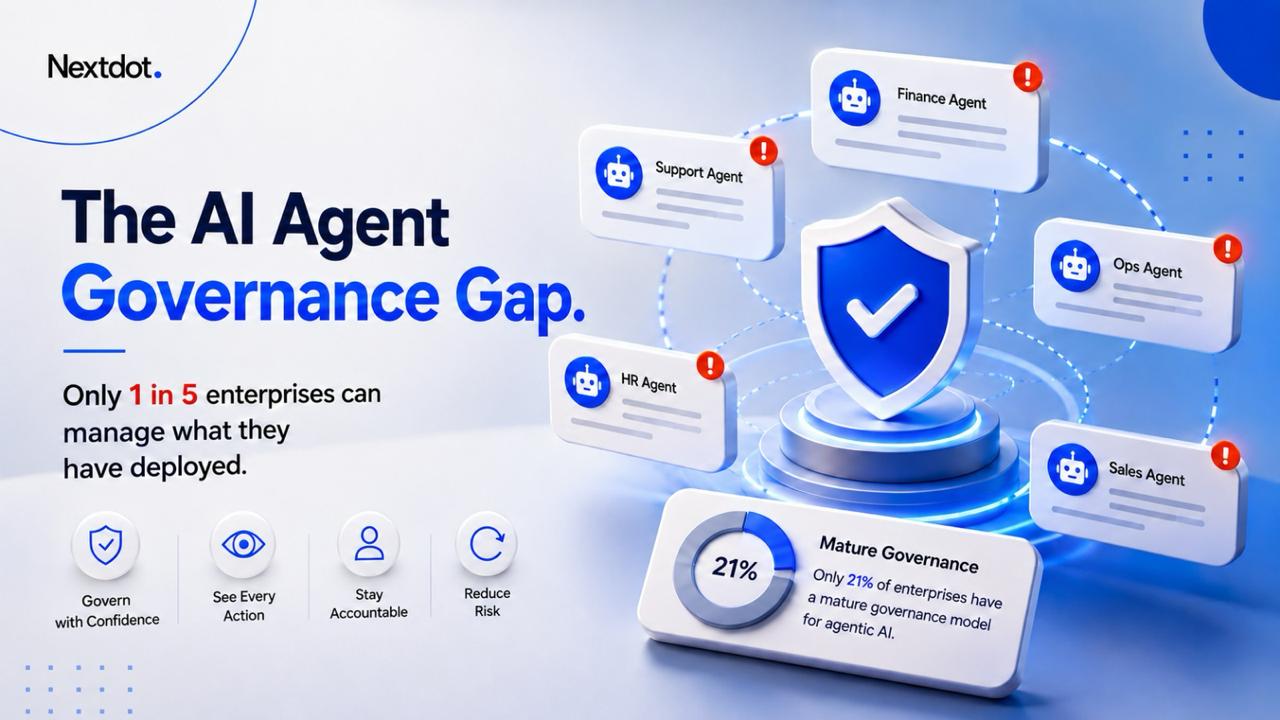
AI agent governance is the set of controls that decide what an autonomous agent is allowed to do, who is accountable when it acts, and how every action is monitored, logged, and reversed. It matters because most enterprises have already put agents into production without any of this. Deloitte's State of AI in the Enterprise 2026 report, based on 3,235 IT and business leaders across 24 countries, found that only 21 percent, roughly one in five, have a mature governance model for agentic AI. The agents are live. The oversight is not.
What is AI agent governance?
Start with what an agent actually is, because governance follows from it. A traditional software system does exactly what you coded. An AI agent takes a goal, decides its own steps, calls tools, reads and writes data, and produces an outcome you did not specify line by line. That autonomy is the whole point. It is also the whole problem.
Governance is the discipline of putting bounds on that autonomy so the outcomes stay accountable. Concretely, it covers five things.
First, authority. Which decisions can an agent make on its own, and which ones require a human to approve before the action commits? An agent that drafts a discharge summary is one risk class. An agent that cancels a patient's appointment or issues a refund is another.
Second, identity and access. An agent acts with credentials. Governance defines which systems it can touch, under whose permissions, and for how long, so a single compromised or confused agent cannot reach data it was never meant to see.
Third, observability. Every step an agent takes should be logged in a form a human can read later: what it was asked, what it decided, which tools it called, what it returned. Without this trail you cannot debug a bad outcome, and you cannot prove to a regulator what happened.
Fourth, escalation and handoff. Governance sets the conditions under which the agent stops and hands control to a person, and it makes that handoff clean rather than a dropped ball.
Fifth, lifecycle. Agents get updated, models get swapped, prompts drift. Governance tracks versions and re-tests behaviour so the agent you audited in March is the same agent running in June.
Put simply, governance answers a single question a CXO should be able to ask on any given day: what are our agents doing right now, and who is answerable for it?
Why does the governance gap exist?
The gap is a timing problem. Adoption ran ahead of control.
The same Deloitte research that found only 21 percent with mature governance also found that close to three-quarters of companies plan to deploy agentic AI within two years, and 85 percent expect to customise agents to their own operations (Deloitte, State of AI in the Enterprise 2026). Demand is near universal. The muscle to manage it is rare. That is the shape of every gap: two curves moving at different speeds.
There are three reasons the control curve lags.
Pilots are easy and production is hard. A single agent in a demo, watched by the engineer who built it, needs almost no governance. The engineer is the governance. Nothing about that experience prepares an organisation for fifty agents running unattended across finance, support, and clinical operations, each with its own permissions and failure modes. The skills that got you a working prototype are not the skills that keep a fleet accountable.
Ownership is unclear. Ask who owns agent governance and you get a shrug that travels around the table. IT says it is a business decision. The business says it is a technical one. Legal and compliance find out an agent exists only after it has done something they have to explain. Governance needs a named owner with authority across all of those functions, and most companies have not appointed one.
The vendor market adds noise. Gartner has warned about "agent washing," the rebranding of older chatbots and robotic process automation as agents, and estimates that only around 130 of the thousands of self-described agentic vendors are building the real thing (Gartner, June 2025). When much of what you buy is labelled generously, you inherit governance debt you did not know you signed up for.
Why does AI agent governance matter?
Because ungoverned agents fail in ways that are expensive, quiet, and hard to unwind.
The most concrete signal comes from Gartner, which predicts that over 40 percent of agentic AI projects will be cancelled by the end of 2027, citing escalating costs, unclear business value, and inadequate risk controls (Gartner, June 25 2025). Read that last phrase carefully. Inadequate risk controls is a governance failure, and it is being named as a leading cause of projects dying in production.
The failure modes are specific. An agent can make a mistake no one sees until it has repeated it a thousand times. Two agents can work at cross purposes, each undoing the other's work. An agent can reveal sensitive information because nobody scoped its data access. An agent can take an action against a customer that no employee would have been allowed to take. Deloitte's own framing is that agents are scaling faster than their guardrails, and that these risks compound as pilots turn into fleets (Deloitte, 2026).
Compounding is the word to sit with. A human error is usually a single event. An agent error is a policy. It runs at machine speed and machine volume until someone notices. The cost of a governance gap compounds as your deployment grows.
For a CXO, the exposure is threefold. There is operational exposure, where a bad agent action disrupts a real workflow. There is financial exposure, where token spend and coordination overhead balloon on work that delivers no measurable value. And there is regulatory exposure, which in India is now sharp enough to plan around.
What does governance look like under Indian regulation?
For anyone operating in a regulated industry here, governance is quickly becoming a legal requirement rather than a good habit.
The Digital Personal Data Protection Act 2023 is the immediate one. If your agent reads, stores, or acts on personal data, you are a data fiduciary, and you owe purpose limitation, consent, and accountability for that data. An agent that pulls a customer's history to resolve a ticket is processing personal data, and you must be able to show why it had access and what it did. This is exactly what an audit trail delivers, which is why observability moves from engineering nicety to compliance necessity. The Digital Personal Data Protection Rules 2025 were notified in November 2025, with the substantive compliance obligations phased to take effect from 13 May 2027, so the time to build these controls is now (MeitY, Digital Personal Data Protection Rules 2025, notified 14 November 2025).
In healthcare the stakes rise. When agents touch clinical or patient-facing workflows, the Ayushman Bharat Digital Mission data standards and the NMC's expectations around patient consent and record integrity all sit on top of DPDP. An agent that handles patient interactions has to keep records that a hospital can defend to a regulator, and it has to know precisely which actions it is permitted to take without a clinician in the loop.
This is the reason we build the way we do. Nextdot runs voice-first CX agents live at Narayana Health and Gleneagles, and in build at Fortis Mulund, and in that setting a compliance-aware governance layer is the difference between an agent you can deploy and one you cannot. Every action logged, clear authority bounds, and a defined human handoff are the baseline, before any conversation about capability. It is the same principle behind NextComply AI, our compliance co-pilot for regulated industries, where every finding is traceable to the clause behind it and anything uncertain routes to a named reviewer.
How do you close the governance gap?
You close it by treating governance as an architecture decision made before deployment, rather than a report written after an incident. Four moves matter.
Name an owner. Give one person or one small cross-functional group real authority over agent governance, spanning IT, legal, compliance, and the business units where agents run. Deloitte's read of the companies succeeding with agents points to exactly this kind of cross-functional structure that sets policy, monitors performance, and manages escalations. Governance without an owner is a document nobody enforces.
Set authority bounds per agent, in writing. For each agent, state plainly which decisions it makes alone and which need human approval. Start narrow. It is easier to widen an agent's authority once you trust it than to claw back authority after it has caused harm.
Make observability non-negotiable. If an agent's actions are not logged in a readable, queryable trail, it is not ready for production. This single control serves debugging, cost analysis, and regulatory defence at the same time.
Govern the orchestration, not only the agent. Most real value comes from several agents and tools working together, and most real failures come from how they coordinate. Governance has to live at the orchestration layer, where you can see the whole chain of actions and stop it cleanly when something drifts. A well-run handoff to a human is a governance feature, and it should be designed in from the first version.
The through line is measured deployment. Start with lower-risk use cases, build the controls, verify behaviour against real workflows, then scale. That is slower than the demo promised. It is the only version that survives contact with production, and with a regulator.
The takeaway for CXOs
One in five is a warning sign. The agents are already in your organisation, or they will be within the year, and the question is no longer whether to adopt but whether you can answer for what they do. Governance is what lets you say yes to that question. Build it before you scale, name someone to own it, and insist on a readable trail for every action. The enterprises that treat governance as architecture will keep their agents in production. The rest will be reading Gartner's cancellation statistic from the inside.
Frequently asked questions
What is AI agent governance in one sentence?
It is the set of controls that define what an autonomous agent may do, who is accountable for its actions, and how every action is monitored, logged, and reversed.
How is agent governance different from regular AI governance?
Regular AI governance largely concerns how models are trained, what data they use, and whether outputs are fair. Agent governance adds the dimension of action. An agent does things in your live systems, so governance has to bound its authority, scope its access, and control its handoff to humans in real time.
Is the "one in five" figure reliable?
It comes from Deloitte's State of AI in the Enterprise 2026 report, a survey of 3,235 IT and business leaders across 24 countries, which found that 21 percent have a mature governance model for agentic AI. It is a named, dated source rather than an estimate.
Does DPDP 2023 apply to AI agents?
If an agent processes personal data, then yes, your organisation is a data fiduciary for that processing and owes purpose limitation, consent, and accountability. An audit trail of the agent's actions is how you demonstrate compliance.
Where should a company start if it has agents live but no governance?
Name an owner, write down authority bounds for each agent, and turn on readable action logging before anything else. Those three steps close most of the immediate exposure and give you the trail you need for everything after.