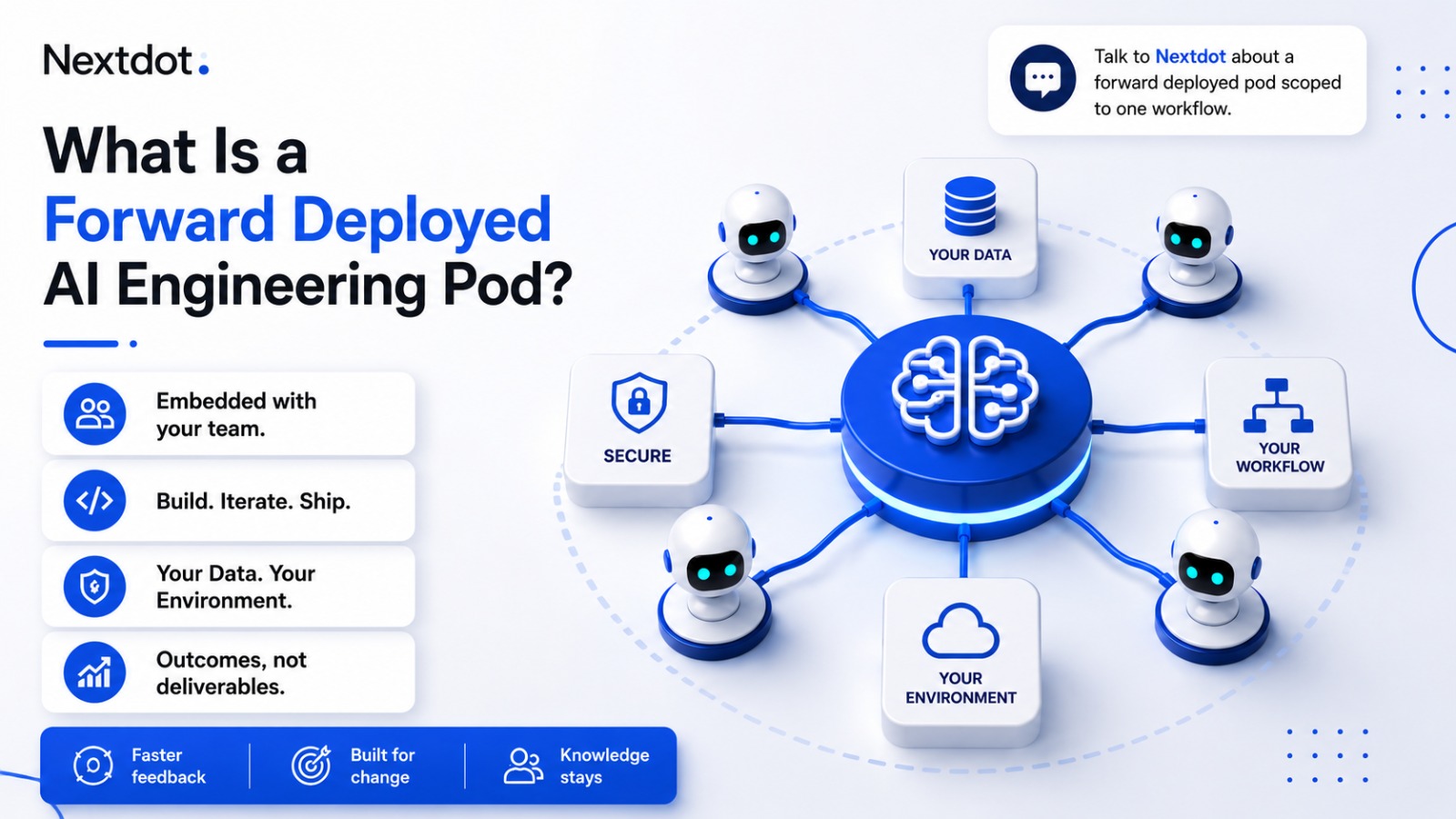
A forward deployed AI engineering pod is a small, senior team that embeds inside your organisation and ships production code on your infrastructure, against your data and your workflow, instead of handing you a demo and a statement of work. The unit is the pod, usually four to six people who cover engineering, orchestration, domain modelling and evaluation. The distinguishing trait is location: the work happens where the problem lives, close enough to your operators that the feedback loop is measured in days. MIT's NANDA initiative found that roughly 95% of enterprise generative AI pilots deliver no measurable P&L impact (Fortune, 18 August 2025). The pod model exists to change which side of that number you land on.
What does "forward deployed" actually mean?
The term comes from Palantir, which built the role in the early 2010s to serve customers whose data could not leave the building and whose requirements kept moving. Until around 2016 Palantir ran more forward deployed engineers than product engineers (Pragmatic Engineer, 2025). The idea has since spread across the AI industry, with OpenAI and Anthropic both standing up forward deployed enterprise ventures in mid-2026 (TechCrunch, 4 May 2026).
Strip away the history and the definition is plain. A forward deployed engineer is a senior builder who sits with the customer and ships working software into the customer's own environment. A pod is a few of those engineers working as one accountable unit rather than a set of contractors billing hours. "Forward" is the operative word. The engineering happens forward of the vendor's office, at the front line where the workflow runs, where the exceptions show up, and where the person who will actually use the system can point at a screen and say what is wrong.
That physical and organisational closeness is the whole design. Enterprise AI rarely fails on model quality. It fails in the gap between what a vendor understood from a requirements document and what the work really demands. A pod closes that gap by living inside it.
How is a pod different from a vendor relationship?
A conventional vendor relationship runs on a specification. You describe the problem, the vendor scopes it, both sides sign, and delivery is graded against the document. The trouble is that in AI work the document is wrong the moment it is signed, because nobody yet knows how the model will behave on your messy, real inputs. The specification freezes assumptions that turn out to be false, and every correction becomes a change request with its own commercial negotiation.
A pod runs on a different contract of trust. The team commits to an outcome on a workflow, then discovers the real requirements by building against production data in short cycles. When an assumption breaks, the pod rewrites the approach in the same week rather than filing a variation. You are buying progress on a problem, and the direction of travel stays yours.
The economics point the same way. MIT's NANDA research found that enterprises buying from specialised partners saw AI deployments succeed roughly 67% of the time, while internal builds succeeded about a third as often (MIT NANDA, "The GenAI Divide: State of AI in Business 2025"). The partnership route wins when the partner behaves like a pod, embedded and accountable, rather than a supplier shipping a licence and a login.
Three differences matter most in practice.
Ownership of the outcome. A vendor owns deliverables. A pod owns the metric you agreed to move, and stays until it moves.
Speed of correction. A vendor corrects through contracts. A pod corrects through commits, because the people who can change the code are in the room with the people who can see the problem.
Retained capability. A vendor leaves with the knowledge. A good pod leaves your team able to run and extend what it built, because your engineers were in the loop the whole way.
Why do so many enterprise AI projects fail without one?
The failure numbers are consistent across independent sources, and they describe a deployment problem more than a technology problem. Gartner expects over 40% of agentic AI projects to be cancelled by the end of 2027, citing escalating costs, unclear business value and weak risk controls (Gartner, 25 June 2025). The RAND Corporation found that more than 80% of AI projects fail, roughly twice the failure rate of comparable IT projects that do not involve AI (RAND, 2024). S&P Global Market Intelligence found the average organisation scrapped 46% of AI proof-of-concepts before production, up sharply year over year (S&P Global, October 2025).
Read those together and a pattern appears. The pilots work in the demo and die on the way to production. The reasons are mundane and they are exactly the reasons a distant vendor cannot see: the data is dirtier than anyone admitted, the workflow has a dozen edge cases that never made it into the brief, the compliance team has a veto nobody surfaced, and the operators quietly route around the tool because it does not fit how they actually work.
A pod is built to surface those reasons early, while they are cheap to fix. Because the team is embedded, the dirty data shows up in week one, the edge cases arrive from the operators themselves, and the compliance veto becomes a design input rather than a launch-day surprise. In regulated industries this is decisive. A voice-first agent that touches patient interactions has to be compliance-aware from the first prototype, which means the pod has to sit close enough to the clinical and legal reality to design for India's DPDP Act, 2023 and NMC guidance while it builds rather than after launch.
What does a forward deployed pod look like inside a company?
A pod is deliberately small and senior. A typical Nextdot pod is four to six people spanning agent engineering, orchestration, domain modelling and evaluation, with a lead who owns the relationship and the outcome. It runs against one workflow at a time, scoped tightly enough that success is measurable inside a quarter.
The rhythm is short. The pod ships a thin production-grade slice fast, puts it in front of real users, watches what happens, and iterates on live signal. Evaluation is a first-class job inside the pod rather than an afterthought, because in regulated work you have to prove the system behaves before you widen its blast radius. That means structured test sets, verified outputs, and a human handoff for anything the system should not decide alone.
Nextdot runs this model from an AI Capability Center, with roughly 30 people organised into pods that deploy into client environments. The public shape of the work is voice-first CX agents live at Narayana Health and Gleneagles and in build at Fortis Mulund, plus NextComply AI, a compliance co-pilot for regulated industries currently in beta and paid POCs. The through-line across those engagements is the same: a compact team embedded against one workflow, shipping code the client's own people can keep running.
Crucially, the pod is a teaching unit as well as a building unit. Your engineers pair with it, your operators shape it, and the intent is that capability compounds inside your organisation. When the engagement ends, you keep a running system and a team that understands it, rather than a dependency you have to renew every year.
When is a pod the wrong choice?
Honesty helps here. If your problem is genuinely solved by an off-the-shelf product, buy the product. A pod is overkill for a commodity need with a mature tool and a clean interface to your data.
The pod earns its cost when three conditions hold together. The workflow is specific to how you operate, so no generic tool fits. The data is sensitive or messy enough that it cannot simply be exported to a vendor. And the outcome is worth a quarter of embedded senior effort, usually because it sits on a revenue line, a compliance obligation, or a cost you can measure. Enterprise AI inside regulated industries tends to meet all three at once, which is why the model fits healthcare, pharma and financial services more naturally than it fits a generic marketing task.
If you are early and only need to learn what is possible, a short scoped engagement on a single workflow tells you more than a year-long platform commitment. Start there, measure the result, and expand only if the first pod moves the number it promised to move.
Frequently asked questions
What is a forward deployed engineering pod in one sentence?
It is a small, senior team that embeds inside your company and ships production AI on your own infrastructure and data, and stays accountable for a business outcome rather than a set of deliverables.
How is a pod different from hiring a consultancy?
A consultancy is usually graded against a specification and bills for effort. A pod commits to moving an agreed metric on a real workflow, corrects course through code in short cycles, and leaves your team able to run what it built.
How big is a pod and how long does an engagement run?
A typical pod is four to six people covering engineering, orchestration, domain modelling and evaluation, scoped to one workflow with a measurable result inside a quarter. Engagements expand only after the first workflow proves out.
Does the pod model work for regulated industries like healthcare?
It fits regulated work well, because compliance becomes a design input from the first prototype. A pod can build to the DPDP Act, 2023 and NMC guidance as it goes, with structured evaluation and a human handoff for decisions the system should not make alone.
What do we keep when the engagement ends?
A running production system and a team that understands it. Your engineers pair with the pod throughout, so the capability compounds inside your organisation rather than leaving with the vendor.